





Banking brands are no longer experienced primarily through branches, advertising or physical collateral. For millions of customers, the mobile app, website, notifications, digital support and everyday product interactions have become the brand. This shift requires banks to go beyond traditional visual brand identity and build a distinctive Digital Brand Identity that translates their strategy, values and promise into recognizable digital behavior. UXDA’s Digital Experience Governance (DXG) system provides a practical, actionable tool to help ambitious financial institutions build strong, future-ready digital brands identities.
Digital Brand Identity in banking is the consistent expression of a financial institution’s strategy, personality and brand promise through its digital experience. It includes not only visual identity, but also interaction patterns, content, tone of voice, motion, personalization, service behavior and the way customer journeys are designed.
Here, Digital Brand Identity does not refer to digital identification, authentication or KYC. It describes something broader: how customers perceive and recognize a bank in the digital space through its experiences, interactions, visual and verbal language, service behavior, emotions and associations.
Why Digital Brand Identity Matters in Banking
Historically, many financial brands were shaped by their physical presence: bank branches, trusted bank tellers in suits and tangible collateral. But in a fully digital ecosystem, these old touchstones fade.
As banking becomes digital-first, customers increasingly form their perception of a financial institution through digital interactions rather than physical branches. Mobile apps, websites, notifications, support, AI assistants and connected services now shape whether a bank feels trustworthy, innovative, premium, human or indistinguishable from competitors.
This makes Digital Brand Identity a strategic business asset—not simply a branding or interface-design concern. It connects what the institution promises with what customers actually experience.
However, bankers struggle to translate customer service from offline to online modes. They are losing brand-driven consistent UX and often associate digital banking with just adding standard features in generic interfaces. But when executed properly, a strong digital brand fills the gap left by the lack of a physical presence and offline banking marketing, providing reassurance, emotional resonance and a compelling reason to choose one financial platform over another.

The battleground has shifted to mobile apps, websites and digital interactions. Without a strong and consistent digital brand, financial institutions risk being overshadowed by nimble Fintech startups or tech giants like Apple and Google that excel in user experience.
A strong Digital Brand Identity helps banks create three strategic outcomes:
- Differentiation: Customers can recognize why this banking experience feels meaningfully different from alternatives.
- Trust: Consistent behavior, communication and design reduce uncertainty and reinforce confidence.
- Loyalty: A coherent and emotionally relevant experience strengthens the relationship beyond individual transactions.
What Is Digital Brand Identity in Banking?
Digital Brand Identity is how a bank’s brand strategy becomes visible and felt through digital experience. While visual identity defines elements such as color, typography and imagery, Digital Brand Identity goes further—it defines how the bank communicates, guides, responds, personalizes, moves and behaves across customer interactions.
A visual identity defines how a bank looks. Digital Brand Identity defines how the bank looks, feels and behaves.
Nowadays, designing a powerful Digital Brand Identity for a financial company doesn’t require costly marketing in banking but, rather, primarily aligning every digital interaction with the core brand promise. Financial digital ecosystem must revolve around the user. Whether it's simplifying onboarding or providing intuitive investment tools, the design should reflect your customers' needs and emotions. As Fintech firms like Robinhood have shown, ease of use can transform how customers view investments.
Robinhood: Digital Brand Identity Through Accessible Investing
Rather than reproducing the complexity of traditional brokerage platforms, Robinhood redesigned investing around simplicity, immediacy and mobile-first interaction. Clear portfolio views, streamlined trading flows, recurring investments and accessible investing tools turn traditionally complex financial actions into intuitive everyday behaviors. The result is a distinctive product identity that communicates accessibility, speed and empowerment. Robinhood’s Digital Brand Identity is therefore expressed not only through its visual language, but through the way the product reduces friction and makes investing feel approachable to a broader audience.

Banks that rely heavily on standardized vendor experiences risk inheriting the same interaction patterns, information architecture and visual conventions as competitors. Differentiation therefore requires a deliberate layer of Digital Brand Identity that translates the institution’s own strategy, personality and customer promise into distinctive product behavior—whether the underlying technology is custom-built or vendor-based.
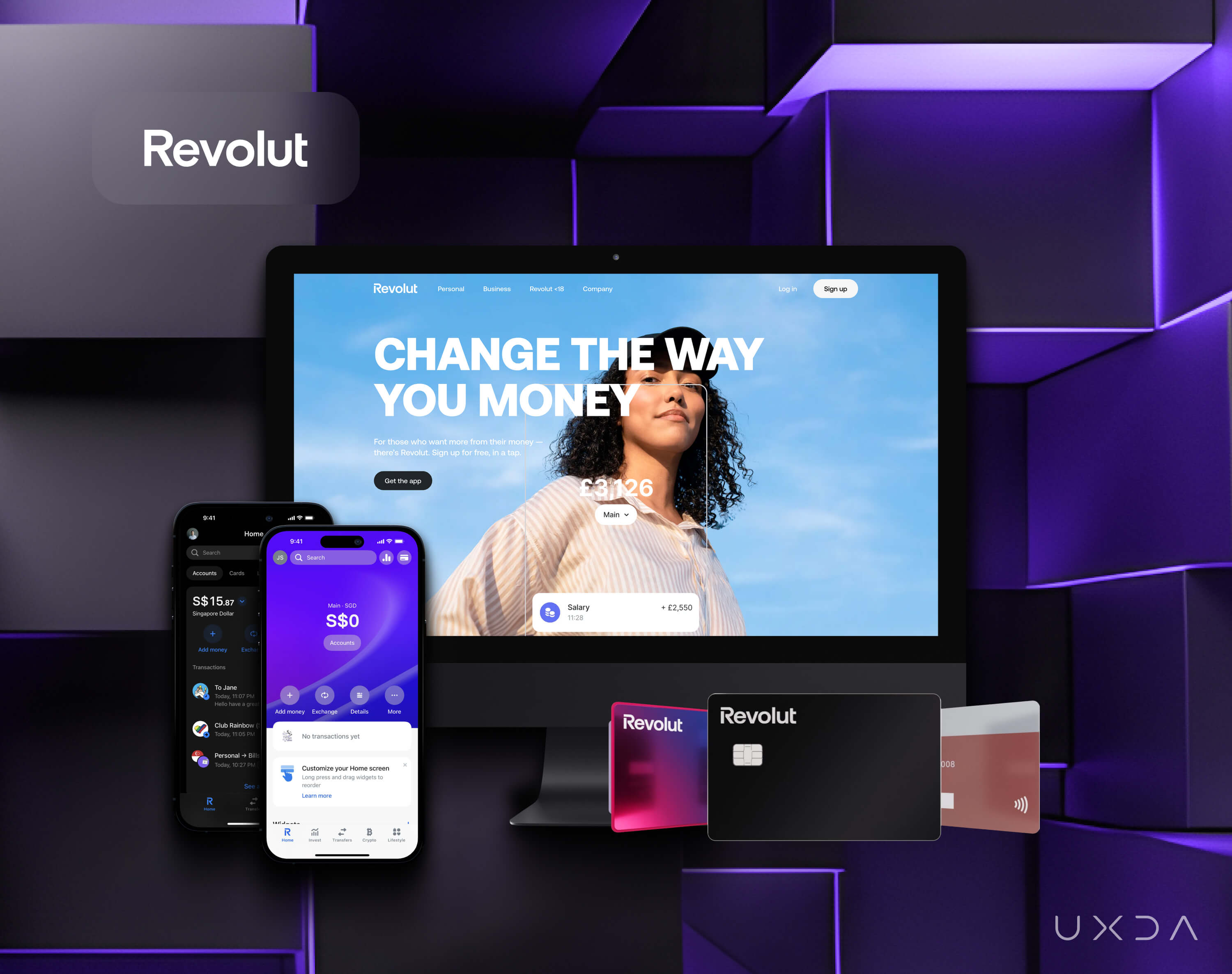
Revolut: Digital Brand Identity Through Product Behavior
Rather than using off-the-shelf vendor solutions, Revolut designed its own user interfaces from the ground up. Each super app element—from the minimalist customizable dashboard to interactive budgeting tools—is tailored to meet customer needs. The result is a unique aesthetic and functional identity that conveys agility, innovation and simplicity. Revolut meets customer needs at every touchpoint, providing contextual guidance, personalized insights and a rich user experience. The Revolut super app offering goes far beyond finance by including cutting-edge lifestyle services.
Consistency in design, tone and functionality—from mobile apps to chatbots—is crucial. For instance, Monzo, a UK-based Fintech, ensures its brand personality shines through in every customer interaction, whether on its app or customer service channels.
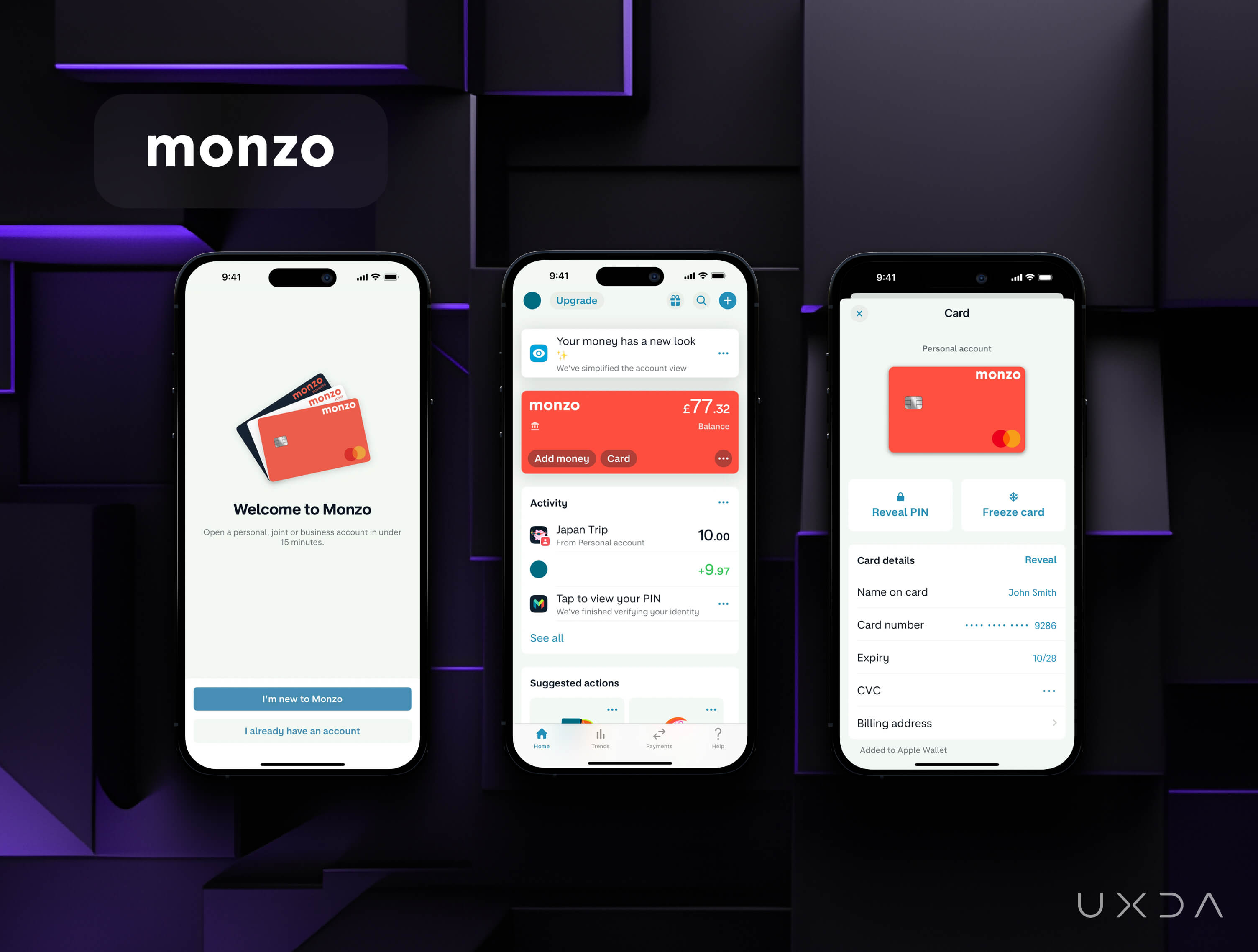
Monzo: Digital Brand Identity Through Voice, Visual Language and Community
The UK-based challenger bank built an app experience that feels more like a lifestyle tool than a traditional financial product. Bright colors, friendly language and micro-interactions turn mundane banking tasks into engaging touchpoints. This distinct look and feel helps Monzo stand out in a crowded market while reinforcing the brand’s personality and approachability. A focus on community building and transparency has turned Monzo’s customers into brand advocates. Their digital products are built to reflect this ethos, ensuring authenticity.
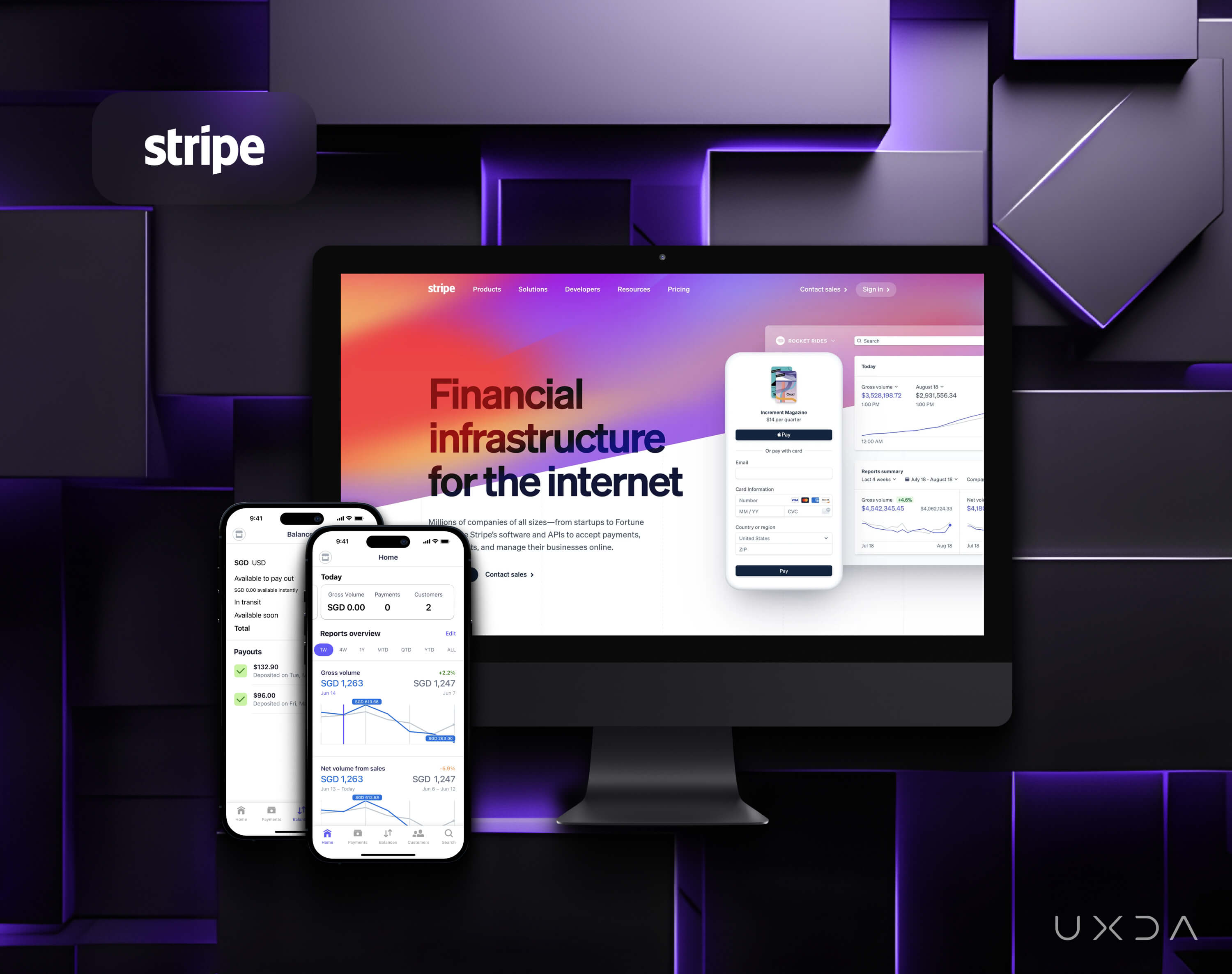
Stripe: Making Financial Infrastructure Accessible
Rather than treating payments infrastructure as an invisible technical utility, Stripe turned the experience of building and managing financial infrastructure into a defining part of its brand. Its APIs, documentation, Dashboard and consistent interface components are designed to make complex payment operations feel structured, understandable and controllable. Stripe extends this experience across payments, billing, platforms and operational tools, creating a coherent ecosystem for developers and businesses. The result is a distinctive Digital Brand Identity built around clarity, flexibility and technical excellence—making the experience of working with Stripe itself part of the competitive advantage.
Chime: Digital Brand Identity Through Simplicity and Guidance
By focusing on intuitive navigation and thoughtful prompts, Chime makes the onboarding process as painless as possible. Clear messaging, positive reinforcement and well-timed nudges guide users through each step, ensuring that the digital brand isn’t just a veneer but a living manifestation of the company’s mission to empower customers financially. By designing its digital experience for everyday users, Chime has redefined banking for millennials. Its tailored features, like no-fee overdrafts, resonate deeply with its audience.
A strong financial brand must effectively communicate its values and services through modern digital tools and platforms. Leveraging social networks, AI chatbots and personalized digital media campaigns helps maintain consistent and engaging communication.
For example, AI-driven customer support systems, like those used by HSBC, ensure quick and branded interactions, and Revolut's social media campaigns resonate with their target audience by blending their unique tone with actionable content. Digital artifacts, such as explainer videos, interactive calculators and gamified content provide an additional layer of engagement that informs as well as entertains. Combined, these tools amplify the brand's reach while reinforcing its core message across digital ecosystems.
These top financial brands have two key qualities in common: authenticity and purpose-driven innovation. They don’t simply buy a standardized online banking module, slap their logo on it and promote their generic app through standard banking marketing. Instead, they start with their brand values and customer needs, then craft tailor-made digital experiences that reflect those principles at every turn. This approach ensures the brand’s digital identity is not only distinctive but also deeply meaningful to customers, turning them into referrals and brand advocates.
By continually revisiting their brand strategy, analyzing user feedback and embracing new technologies, these Fintech brands never lose sight of what made them successful in the first place. They differentiate themselves from competitors not just through better rates or product features, but by delivering a cohesive, emotionally resonant experience that aligns with their brand’s promise and purpose. A modern Digital Brand Identity isn’t just about colors, logos and fonts. It’s a holistic system that weaves together strategy, design, functionality and authenticity.
What Makes a Digital Brand Identity Strong in Banking?
A strong Digital Brand Identity emerges when customers repeatedly experience the same distinctive promise through the way a bank looks, communicates and behaves. It requires more than consistency: the experience must also be recognizable, relevant and meaningfully different from competitors.
To thrive in this new age, financial brands must think beyond standard functionality. They must craft authentic, meaningful digital experiences that consistently reassure, delight and inspire. The payoff? A loyal, engaged customer base that views the brand as a trusted digital partner in achieving their financial goals.
In a digital-first world, trust is established not through marketing in banking, but through the quality and reliability of each interaction. Customers have countless alternatives at their fingertips, so even a minor friction point—an overly complex onboarding form or inconsistent messaging between mobile and web—can lead them to abandon one platform for another.
Consistency, therefore, is not just “nice-to-have” but crucial. When a brand’s values and messaging are seamlessly integrated into every touchpoint, it creates a sense of stability and reliability. Over time, this fosters customer confidence and cements brand loyalty. A thoughtful, unified experience sends a message that the institution cares deeply about its customers’ time, comfort and aspirations.
Digital Experience Is Where Brand Identity Becomes Real
In the decline of physical branches, digital is your storefront. Cash App’s online-only e-wallet, for example, has built a reputation and gained as a tech-first banking provider with no branches by consistently innovating its digital platform. As of 2024, Cash App reports 57 million users and $14.7 billion in annual revenue.
Advertising can promise simplicity, care or innovation. Digital experience proves whether those promises are true. Every onboarding step, transaction, notification, error message, recommendation and support interaction either reinforces the brand identity or weakens it.
Avoiding the Banking UX Clone Trap
When multiple banks rely on similar functionality, vendor patterns and industry conventions, usability alone rarely creates meaningful differentiation. Digital Brand Identity introduces recognizable visual, verbal, behavioral and emotional characteristics that make one institution’s experience feel unmistakably its own.
Nubank, for instance, created a completely custom user experience, ensuring every element aligns with its bold and disruptive brand personality. This authenticity is what attracts and retains millions of loyal customers, increasing Nubank’s customer roster from 41.1 million to 91.7 million in the last three years.
Making Digital Brand Identity Trustworthy
Consistency creates recognition; recognition reduces uncertainty; and reduced uncertainty strengthens trust. In financial services—where customers entrust institutions with money, data and major life decisions—this relationship makes Digital Brand Identity especially important.
A disjointed experience—say, radically different functionality between a mobile app and desktop dashboard—can erode trust. Fintech leaders like Chime, Revolut and Monzo excel by ensuring authenticity across every touchpoint—from notifications to in-app support.
The 5 Elements of a Strong Digital Brand Identity
1. Brand Strategy and Positioning: What the Bank Stands For
Before embarking on a digital brand makeover, financial institutions must clarify their mission, values and brand promise. In a crowded Fintech market, what fundamental purpose do they serve, and how do they do it differently from everyone else?
2. Digital Experience: How the Brand Behaves
A brand is only as strong as the experience it consistently delivers. The user journey—from the first login screen to the advanced investment dashboard—must reflect the institution’s identity. Seamless navigation, personalized product recommendations and intuitive interactions differentiate leading brands from generic alternatives.
3. Digital Visual Language: How the Brand Is Recognized
This goes beyond a simple color palette. It’s about delivering a cohesive identity that adapts gracefully across mobile, tablet, desktop, wearable devices and even virtual reality interfaces. The identity’s look and feel should be instantly recognizable no matter where and how the customer engages.
4. Voice and Emotion: How the Brand Communicates and Feels
Authentic storytelling and transparent communication help forge a genuine emotional bond. Customers today expect more than just transactional efficiency. They want to know the institution’s vision, how it uses technology ethically and how it serves communities, and it also should be reflected in your digital banking marketing activities
5. Governance and Scalability: How Identity Stays Coherent Over Time
A digital brand is never “finished.” Platforms evolve, user preferences shift, and new technologies emerge. The most successful brands are agile, continuously refining their identity to meet the evolving needs of their customers.
Traditional brand identity primarily establishes how an institution presents itself through visual and verbal assets. Digital Brand Identity extends that identity into behavior. In banking, it determines not only how the app looks, but how onboarding guides customers, how errors are explained, how financial complexity is simplified, how personalization works, how support responds and how consistently the brand promise is experienced across journeys.
Is it possible to combine all these elements into a clear and straightforward framework? We have found a successful solution and tested it with our clients.
UXDA’s Digital Brand Identity Framework for Banking
Across more than 150 financial product projects in 39 countries, UXDA repeatedly encountered the same gap: financial institutions invested heavily in brand and digital transformation, yet only a fraction of that strategic identity was consistently translated into the customer experience.
The complex needs of financial institutions and their clients are not well met by standard design and development methodologies, even if digital services have emerged as the main delivery channel. This leads to fragmented and impersonal user experiences that don't live up to the standards set by contemporary digital innovations.
UXDA’s Digital Experience Governance (DXG) system provides a structured way to translate Digital Brand Identity from strategic intent into everyday customer experience. It connects five layers—Strategy, Market, Services, Ecosystem and Governance—so the bank’s brand promise is consistently expressed through products, interactions and touchpoints.
Instead of viewing branding as just a logo or color scheme, this model encourages a holistic approach in which the brand’s core strategy, market positioning, service offerings and ecosystem alignment all contribute to a cohesive, meaningful digital experience.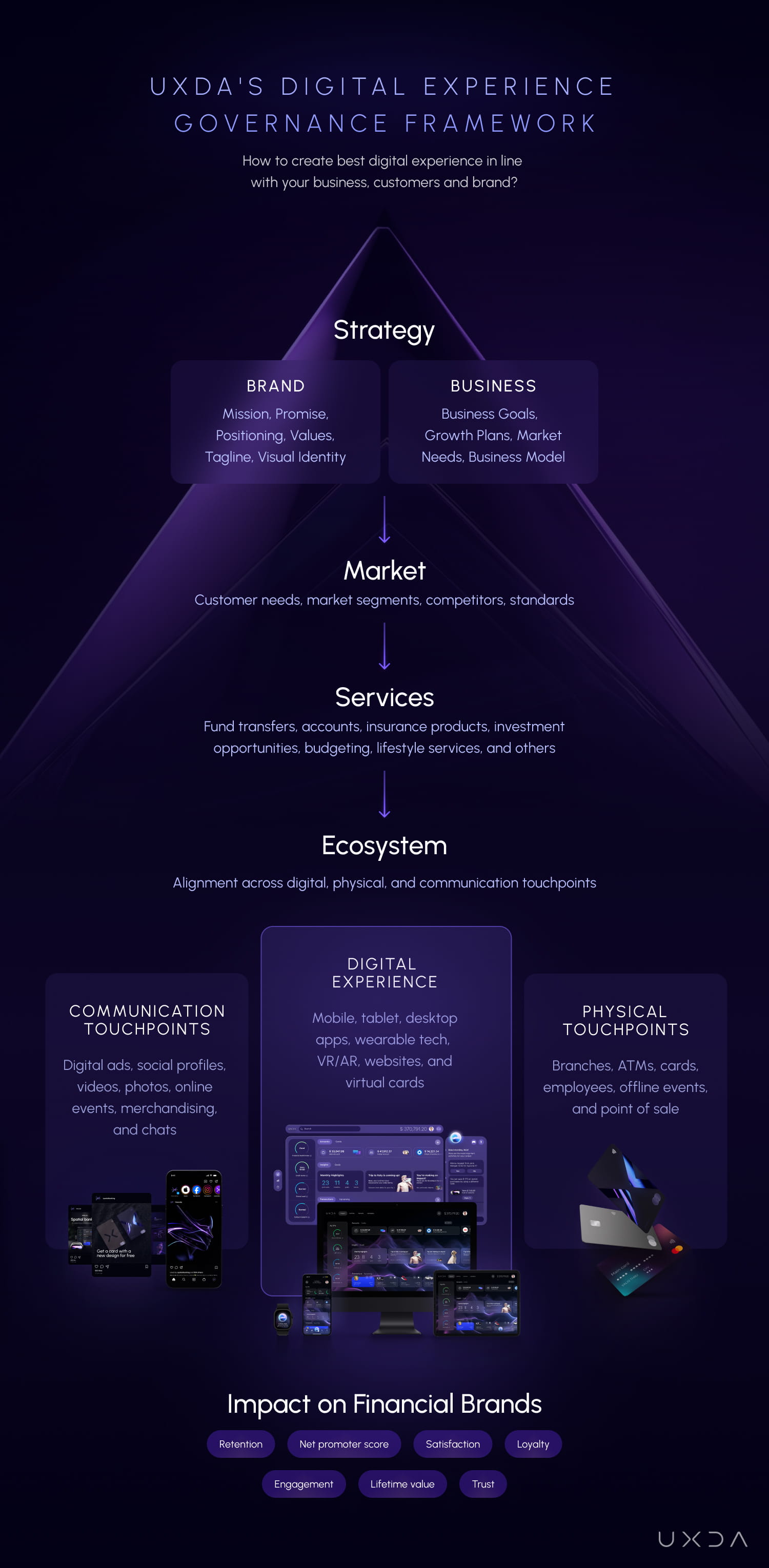
Here’s how it helps build a strong financial brand suited for the digital age:
1. Strategy: Align Brand Promise With Business Goals
A strong Digital Brand Identity starts by defining what the institution stands for, whom it serves, how it intends to differentiate and what promise customers should consistently experience. That promise must be aligned with the bank’s commercial strategy rather than treated as a marketing statement.
A successful digital financial brand integrates two foundational pillars:
- Brand: Define the mission, promise, positioning, values, tagline and visual identity that reflect your organization's unique purpose.
- Business: Align the brand with business goals, growth plans, market needs and the overall business model.
By clearly defining these foundational elements, the institution establishes a strategic compass that informs all subsequent branding efforts. We need to align every digital touchpoint—from a mobile banking app to a social media campaign—reinforcing the brand’s core identity rather than presenting a fragmented image.
Take, for example, the Fintech brand identity of Revolut or Stripe. Their strategies combine a clear brand mission with the business objective of delivering growth through tailored, user-friendly digital platforms.
2. Market: Ground Digital Brand Identity in Customer and Competitive Insight
Digital Brand Identity cannot be created in isolation. It must occupy a distinctive position between what customers value, what competitors already deliver and what the institution can authentically own.
By bridging strategy and market understanding, the institution aligns its brand with evolving consumer expectations and industry benchmarks. This ensures that the brand voice and experience aren’t developed in isolation but actively resonate with what customers truly want and need.
The financial landscape is highly competitive. A strong digital brand focuses on customer needs, market segmentation, competitor positioning and industry standards to create experiences that truly resonate.
Fintech disruptors like Chime and Cashapp succeeded because they understood the frustrations of underserved users and created solutions that simplified banking for specific segments—millennials and digital natives. By listening to customer pain points, they designed products that met real needs while aligning perfectly with their brand promises.
3. Services: Turn Financial Products Into Brand Experiences
Accounts, payments, cards, lending and investments increasingly converge around similar functionality. Digital Brand Identity turns these functional services into distinctive brand experiences by shaping how they are explained, accessed, personalized and emotionally experienced.
Instead of delivering generic offerings, each product and feature becomes an opportunity to embody the brand’s mission, solve customer problems and differentiate themselves from their competitors. This turns functional services into meaningful brand moments, making them memorable and emotionally resonant rather than purely transactional.
Strong financial brands deliver tailored products and services that align with user expectations and business goals. These include:
- Fund transfers, accounts and payments
- Investment tools for first-time investors
- Insurance products and budgeting tools
- Lifestyle services and personalized recommendations
For instance, Robinhood disrupted traditional investment services by offering simple, engaging tools for novice investors. Their mobile-first approach and transparent brand message—“democratizing finance”—align seamlessly with their service offerings.
4. Ecosystem: Express One Digital Brand Identity Across Every Touchpoint
Customers do not experience organizational silos. They experience one bank. We call it Bank-as-a-Product. The same identity therefore needs to remain recognizable across mobile, web, AI assistants, notifications, customer support, branches, ATMs, cards and emerging channels—even when different teams or vendors are responsible for them.
The framework emphasizes ecosystem alignment, ensuring that these diverse touchpoints tell a consistent brand story. Whether a customer is interacting with a chatbot at midnight or visiting a branch during the day, the brand identity, values and messaging should feel coherent and familiar.
A modern financial brand thrives when it provides an omnichannel ecosystem that aligns:
- Communication Touchpoints
- Digital Experience
- Physical Touchpoints
This unified approach ensures overall brand consistency, improves trust and enhances usability across every interaction.
Communication Touchpoints: Make the Brand Voice Recognizable
Any modern financial brand communicates its value and personality across digital channels through:
- Tone of Voice;
- Terminology;
- Notifications;
- Marketing;
- AI assistants;
- Support;
- Contextual Communication;
- Digital Ads;
- Social Profiles;
- AI Chatbots;
- Videos and Digital Artifacts;
- Influencer Marketing in Banking.
For example, Monzo leverages social media and user-centric campaigns to reflect its transparent and community-driven ethos, ensuring the brand feels approachable and relatable.
Digital Experience: Turn Brand Promise Into Product Behavior
Digital experience is where Digital Brand Identity becomes behavior. Navigation, interaction patterns, motion, personalization, language, guidance, error handling and service recovery all communicate what kind of institution the customer is dealing with. This includes:
- Mobile, tablet and desktop apps.
- Wearable tech, VR/AR tools and gen AI chatbots.
- Virtual cards and third-party platforms.
A bank that promises “simplicity” should not merely use minimalist visuals; it should simplify decisions, explain financial complexity clearly and remove unnecessary effort from key journeys.
Fintechs like Revolut and Chime prioritize custom-built interfaces over off-the-shelf solutions to provide tailored digital journeys that align with user needs, differentiate themselves from competitors and strengthen their brand. The result? High retention, loyalty and brand advocacy.
Physical Touchpoints: Extend Digital Brand Identity Beyond the Screen
While digital dominates, physical touchpoints remain essential for incumbent financial companies. Branches, ATMs, cards, events and service interactions should reinforce—not contradict—the behaviors and expectations established digitally. But even offline digital technologies will drive transformations to enrich customer experience:
- Branches will be transformed into “phygital” spaces using digital tech.
- ATMs transformed into smart "one-stop" ATM stations.
- Support and service call centers will be transformed with gen AI solutions.
- Events marketing and offline advertising (outdoor displays/kiosks) will be enriched through video.
To create a holistic experience, physical touchpoints must mirror the digital brand identity and include digitally-enriched experiences. Akbank demonstrates this perfectly by integrating digital innovation with redesigned physical branches in the “Next Generation Akbank Branch Model,” which reflect its tech-first identity rebranding.
5. UX Governance: Turn Digital Experience Into a Managed Strategic Asset
As financial organizations scale, digital experiences are shaped by multiple products, teams, channels, technologies and vendors. Without strong UX governance, even well-designed individual features can gradually create fragmentation, inconsistency and experience debt across the ecosystem.
UX governance establishes the principles, standards, decision-making processes and accountability needed to manage digital experience systematically. It connects business strategy, customer needs, design, technology and operations so that every new initiative strengthens the overall experience instead of creating another isolated solution.
Rather than treating UX quality as the responsibility of individual projects, strong financial brands manage it as an ongoing strategic capability. This helps organizations protect consistency, accelerate delivery and ensure that digital products evolve in line with both customer expectations and business priorities.
Effective UX governance can include:
- UX strategy, principles and experience standards
- Design systems and cross-channel consistency
- UX research and customer insight frameworks
- Design quality assurance and decision-making processes
- UX metrics, experience monitoring and continuous improvement
- Roles, responsibilities and collaboration models across teams
For instance, UXDA helps financial organizations establish UX governance frameworks that connect strategy with everyday product decisions. By creating shared principles, standards, design systems, research practices and quality controls, banks can reduce experience fragmentation and UX debt while enabling multiple teams to deliver a more coherent, distinctive and continuously improving digital experience.
Digital Brand Identity Case Study: Emirates NBD
For Emirates NBD, the challenge was not simply to modernize interfaces but to translate the institution’s brand strategy and values into a coherent digital ecosystem. UXDA applied the DXG approach to connect brand identity with digital experience across digital ecosystem while establishing scalable design consistency across divisions.
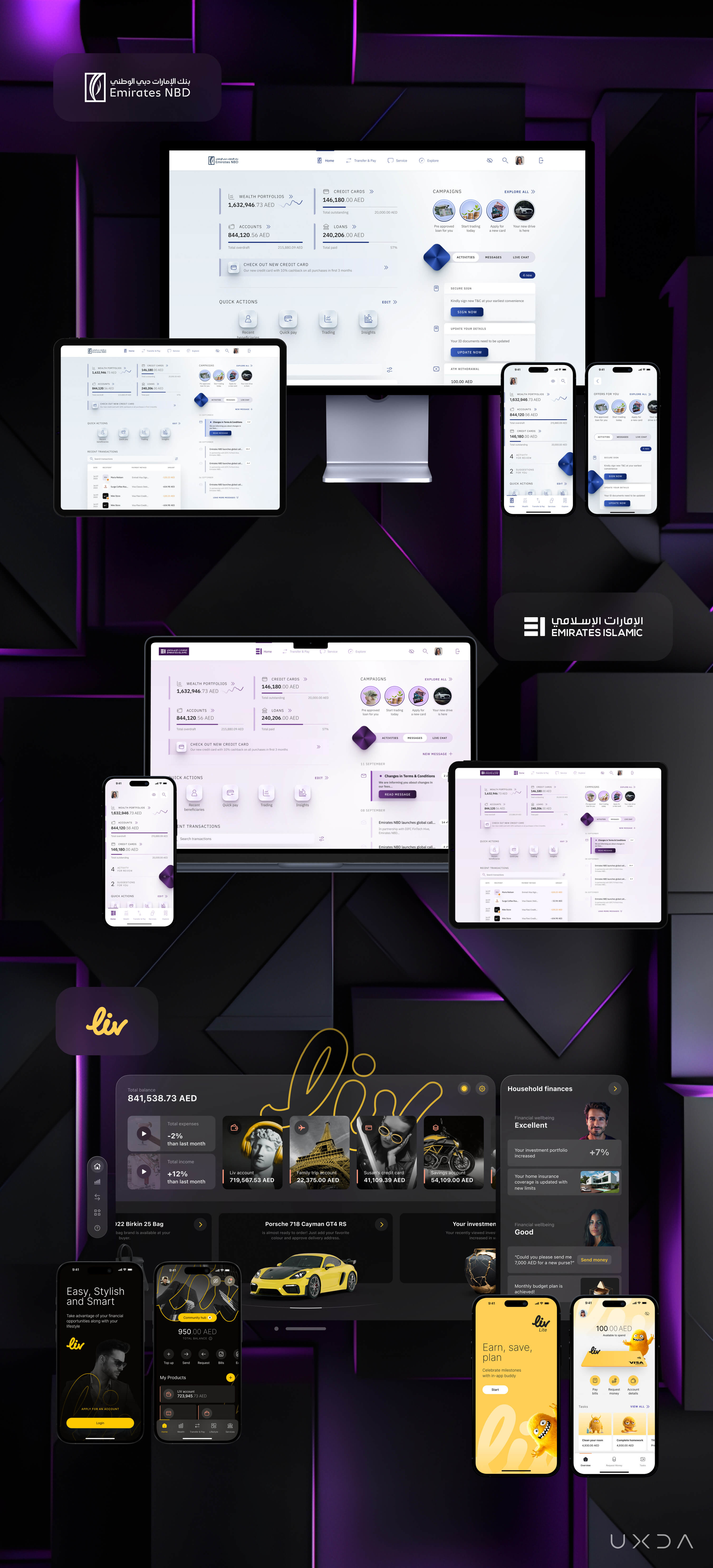
UXDA's DXG (Digital Experience Governance) system enabled a seamless Emirates NBD digital experience evolution by integrating brand strategy, values and identity with cutting-edge product design. This supported Emirates NBD in pioneering its entire digital ecosystem innovation across contemporary digital platforms.
Such a strategic UX approach through UXDA's framework has delivered remarkable results: a 91% digital adoption rate on the ENBD X app, a 1,600% increase in wealth clients, a 50% surge in transaction activity, an app rating improvement from 2.0 to 4.7 on the App Store and recognition as the region's top banking app in 2023.
Conclusion: Digital Brand Identity Turns a Bank’s Promise Into Customer Experience
Digital Brand Identity closes the gap between what a bank promises and what customers actually experience. It connects strategy, market positioning and customer insight with services, communication, digital interactions and physical touchpoints—turning an abstract brand promise into recognizable everyday behavior.
Consistency alone is not enough. The identity must also be distinctive enough for customers to recognize why this bank feels different and authentic enough for that difference to be credible.
In the digital age, strong financial brands connect communication with experience so that what the bank says and what the customer actually encounters reinforce the same identity. A clear strategy, user-driven services and a seamless omnichannel ecosystem allow financial companies to:
- Build trust through consistency
- Establish loyalty by meeting user needs
- Achieve growth by differentiating from competitors
By adopting the UXDA's DXG system, financial institutions can craft digital experiences that inspire, engage and deliver real value to customers.
In finance, UX is increasingly the brand differentiator. The framework underscores that brand-building isn’t separate from user experience—these elements are intertwined. By connecting strategic brand elements directly to digital interfaces and customer journeys, the institution can create intuitive, visually compelling and user-friendly digital platforms. This approach transforms the brand from a static concept into a living, breathing experience that delights users and reinforces brand promises.
DXG system ensures authenticity. It encourages financial institutions to first define who they are and what they stand for, then manifest these qualities through products, services and every point of contact with customers. In the digital age, trust is built through consistent, transparent interactions. The system’s holistic approach ensures that authenticity—once established at the strategic level—carries through to the smallest details of the user experience, strengthening customer trust over time.
The financial landscape is dynamic. The framework’s layered structure makes it easier to identify where changes can be made to maintain relevance. If customer needs evolve or new technologies emerge, the institution can return to earlier layers (e.g., market insights, services, ecosystem touchpoints) to adjust brand strategies and realign experiences, ensuring the brand remains fresh, competitive and aligned with customer expectations.
In the words of former ING’s CEO Ralph Hamers, “If you want to compete in the world of tech and if you, increasingly, want to become a tech company, you have to organise like a tech company.” Now is the time for every financial brand to step up and deliver experiences worthy of the digital age.
The financial industry’s future is digital, and success depends on your ability to align business goals, brand values and user experience. Fintech leaders like Revolut, Nubank and Chime have shown that a strong digital financial brand identity is not just about sleek design or functionality—it’s about delivering a human-centric, consistent and engaging experience across every interaction.
In digital banking, brand is no longer only what the institution communicates. Brand is what customers repeatedly experience. Digital Brand Identity is the system that makes that experience recognizable, distinctive and coherent.
Get UXDA Research-Based White Paper "How to Win the Hearts of Digital Customers":

If you want to create next-gen financial products to receive an exceptional competitive advantage in the digital age, contact us! With the power of financial UX design, we can help you turn your business into a beloved financial brand with a strong emotional connection with your clients, resulting in success, demand, and long-term customer loyalty.
- E-mail us at info@theuxda.com
- Chat with us in Whatsapp
- Send a direct message to UXDA's CEO Alex Kreger on Linkedin