



The traditional UX design approach may not be sufficient for the financial sector because it often focuses on surface-level interfaces and behavior patterns and is limited in addressing the complex, high-stakes nature of money. A systemic user experience design approach prioritizes long-term customer trust and emotional security over simple task completion or short-term conversion metrics. The systemic experience approach shifts UX from interface optimization to decision architecture in digital systems, aligning business objectives, brand intent, market context and customers’ needs.
Systemic UX in banking is an approach to Financial UX Design that treats customer experience as the outcome of an interconnected system rather than a collection of individual screens, features or journeys. It examines how customer behavior, business strategy, risk, technology, policies, operations, Digital Brand Identity and organizational decisions work together to shape financial experiences over time.
Traditional Banking UX Design remains essential for making interfaces clear, intuitive and usable. But financial services create challenges that extend beyond the interface: delayed financial consequences, uncertainty, regulatory constraints, complex product logic, emotional pressure, operational dependencies and high-stakes decisions.
This means a banking journey can be perfectly usable at the screen level while the wider experience still fails. A customer may complete a loan application easily but misunderstand its long-term implications. A payment flow may convert successfully while unclear transaction states later generate anxiety and support demand. A modern banking app may look coherent while policies, support and back-office processes contradict the experience it promises.
Systemic UX expands Financial UX Design from optimizing individual interactions to designing how the entire financial experience behaves. The objective is not to replace traditional UX methods. It is to connect them with the wider system that determines customer trust, business value, risk and long-term experience quality.
Trust is particularly important in financial services because customers depend on institutions to safeguard money, explain complex decisions and behave predictably when something goes wrong. Customers compare their financial apps not just against other competitors, but against every seamless digital experience in their lives.
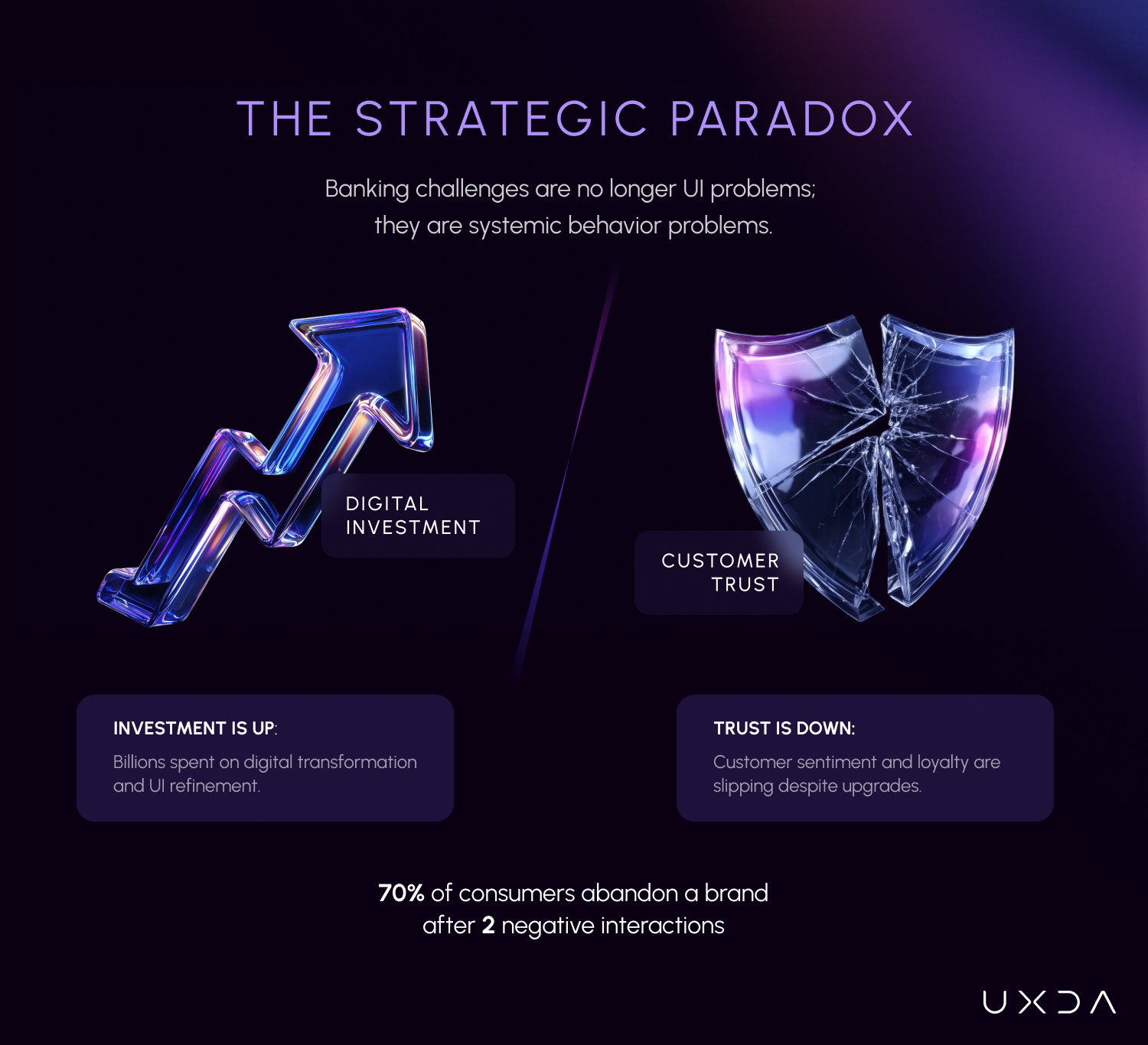
Even one bad experience can send a customer running. Seventy percent of consumers say they’ll abandon a brand after just two negative interactions, and 25% will leave after only one. In an era when switching banks is easy and Fintech alternatives abound, a few UI tweaks, lean UX redesign or flashy new features won’t fix this. A deeper change in approach is needed.
Why Traditional Banking UX Is Not Enough for Complex Financial Services
Traditional UX was born in a different world—a world of e-commerce, media platforms, SaaS tools, lean startups and digital task completion. In that world, UX effectively optimizes usability, speed, clarity, friction reduction and conversion.
Many widely used UX practices are optimized for improving individual tasks, interfaces and conversion journeys. Those methods remain valuable, but financial services often require a wider system-level perspective. They deal with fear, uncertainty, delayed consequences, asymmetric information, irreversible decisions, legal responsibility, high failure cost—factors that extend far beyond a single screen.
Traditional UX methods are essential to banking UX design, but their impact becomes limited when UX is confined to optimizing individual screens and journeys. Financial services combine usability with risk, regulation, behavioral consequences, operational complexity and long-term customer relationships. When someone uses a banking product, they are not just “using an interface.” They are making decisions that could deeply affect their future. And traditional UX is not enough for that.
Traditional UX design tends to focus on individual touchpoints: making a screen or user flow as easy as possible in the moment. It asks, “How can we make this step or button more convenient for the user?” and often tackles problems reactively after the product is already defined.
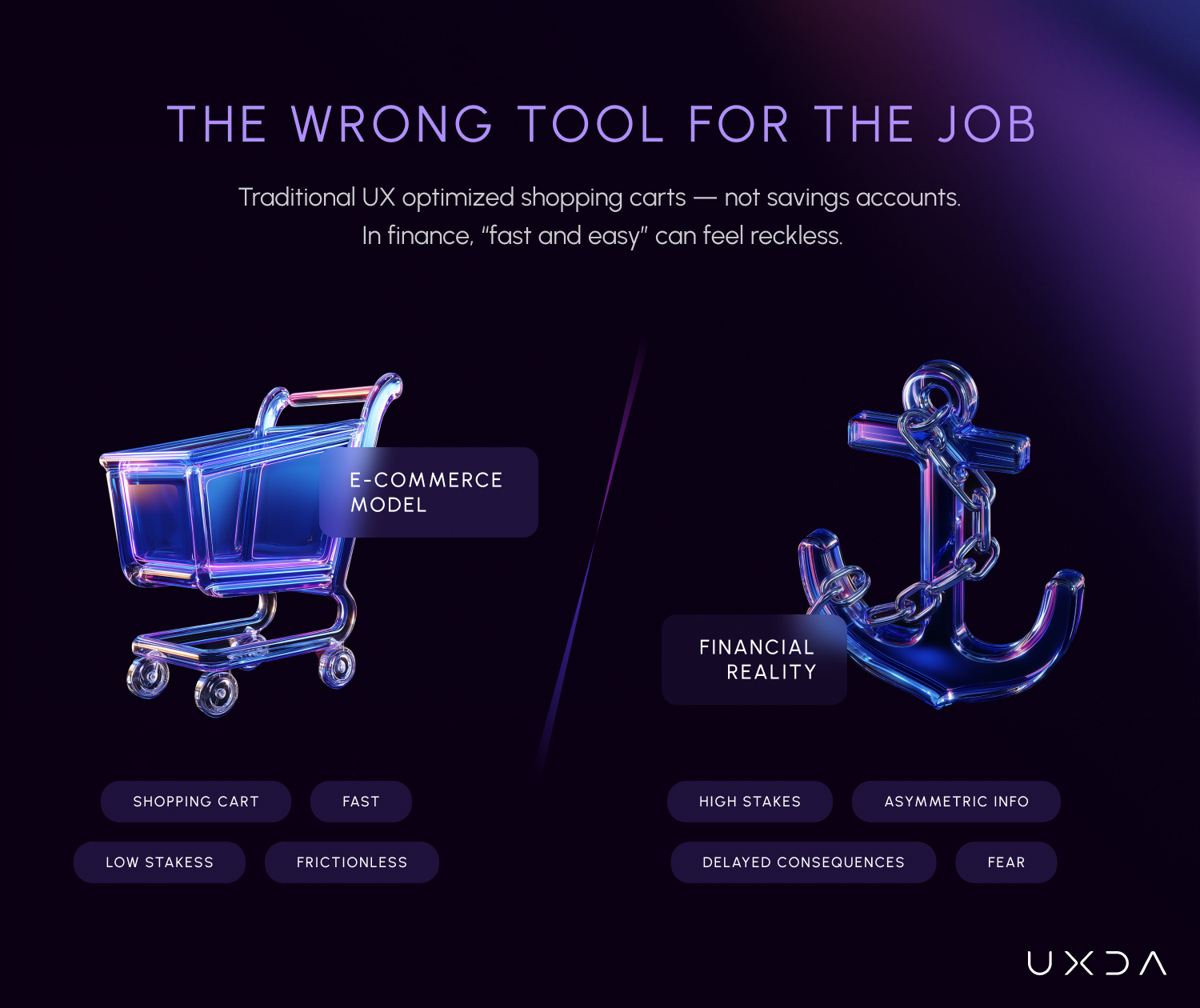
Traditional UX in banking and financial services doesn’t fail because digital product designers lack skill. It fails because the scope of UX is narrowed. In financial organizations, UX design is usually isolated from the very things that define whether a financial service succeeds or fails.
Traditional UX practices often operate as if these elements are external or “out of scope”:
- Brand identity and value proposition
- Business strategy and financial goals
- Executive and cross-team alignment on UX strategy
As a result, UX optimizes inside a vacuum. Digital product screens improve. Flows get cleaner. But the financial service doesn’t become stronger on a strategic level.
For digital financial services, we need a holistic view. We should systematically apply a systemic UX design. It asks, “How does the entire system behave toward the user (and the business) over time and across long-term contexts?”
Systemic UX improves banking user experience by addressing the structures behind recurring customer friction rather than repeatedly optimizing individual interfaces. It helps connect products, channels, policies, communications, service and internal operations so customers experience fewer contradictions and can better understand how the bank behaves.
Financial UX Design is the broader discipline of designing financial products and services. Systemic UX is one methodology within that discipline, particularly useful when customer outcomes depend on relationships between many products, processes, rules and organizational decisions.
Traditional UX vs. Systemic UX in Banking
Instead of treating the interface as the center of the universe, systemic UX design treats the digital product, its UI and UX as just one part of a broader system. This system includes the user’s mindset, the brand identity and positioning, the digital ecosystem consistency, market context, the business model, technology constraints and opportunities, legal requirements and long-term impacts.
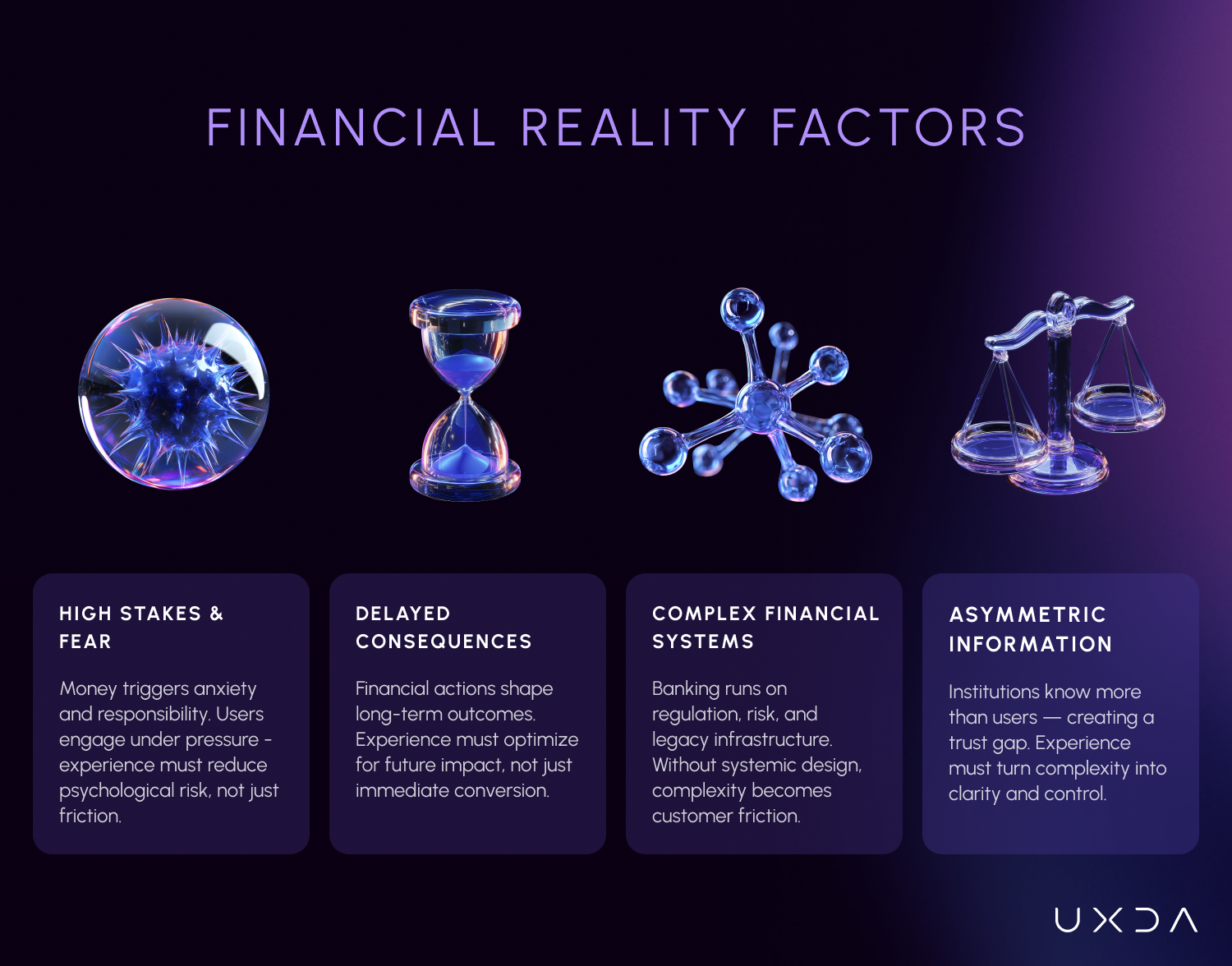
Traditional UX design is not wrong; making interfaces intuitive is necessary. The failure is that it’s not sufficient for financial services. Consider the unique nature of banking, investment and insurance products:
High-Stakes Financial Decisions and Emotional UX
Money triggers deep emotions—anxiety, fear, greed, trust, regret. Users often approach financial interfaces with stress or skepticism. A generic UI can’t overcome the fear of losing one’s savings or confusion about a loan’s terms. Without designing for emotional states and cognitive biases, a financial app that’s “usable” in a lab can still feel intimidating or risky in real life.
Financial UX Has Delayed Customer Consequences
In finance, the real outcome of a user action often comes much later. Taking a loan, making an investment or missing a payment doesn’t show its full impact immediately. If UX is only optimizing the immediate transaction (e.g., “user successfully invested money in 3 clicks!”), it may ignore what happens afterwards—will this user regret their action in a year? Traditional UX tends not to own that question, but systemic UX must. Otherwise, it could lead to disaster. You will get good conversion but poor retention, or even backlash, when reality hits later.
Banking UX Operates Inside Complex Financial Systems
Financial products operate within complex systems (e.g., hundreds of features, trillions of transactions, risk models, fraud detection, regulatory compliance like KYC/AML, etc.) that sometimes override or alter the user’s experience. For example, a fraud system might block a user’s transaction unexpectedly, or a regulation system might mandate extra steps. If the UX is not designed systemically, experiences will feel like random, frustrating disruptions that ruin customer satisfaction. A user who gets a cryptic “transaction denied” message because of an unseen risk rule will blame the bank. Traditional UX might consider that an edge-case error message. Systemic UX treats it as an inevitable scenario to design for.
Trust and Information Asymmetry Shape Financial UX
There’s an inherent information asymmetry in finance—the institution knows more about the rules and the fine print than the user does. Traditional UX often fails by either overwhelming users with information or hiding it entirely. Neither builds trust. Systemic design looks for a balance: how to be transparent and supportive, giving users control without burdening them with complexity. In banking, trust is UX—if your user interface is clear and human, users perceive the service as safer and more reliable. A fancy new feature won’t matter if customers don’t feel secure and respected when using it.
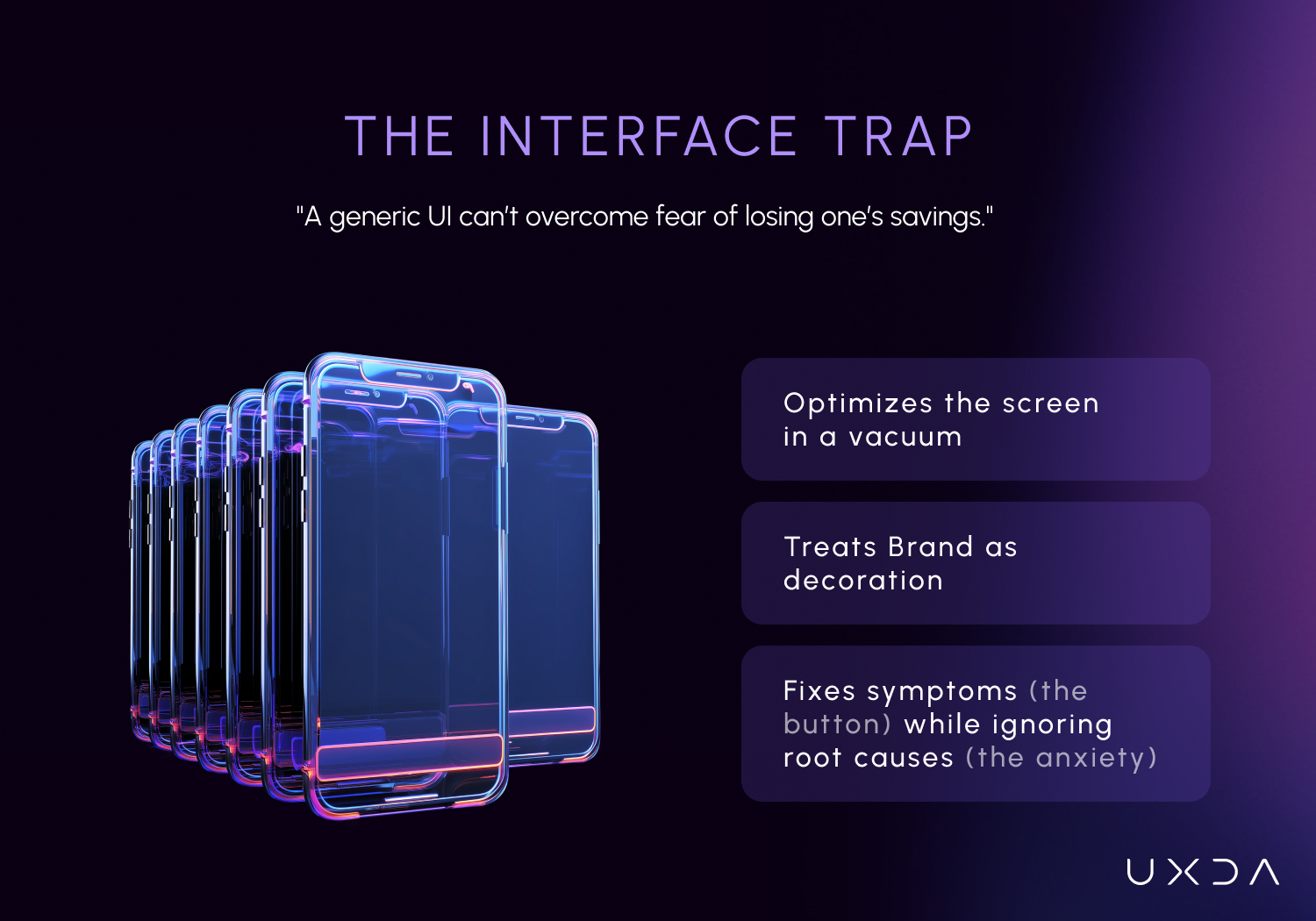
Given these factors, it’s clear why an interface-focused UX design falls short in financial services. Banks often see a paradox: “We improved our app’s design, but customers still don’t engage more, and they still drop off when stressed.” The problem isn’t the UI details; it’s the underlying experience architecture.
Banking experience architecture is the underlying structure that determines how products, journeys, rules, information, interactions and service channels work together across the customer relationship. It goes beyond interface architecture because it includes the behavioral and operational logic behind what customers experience.
Systemic UX uses experience architecture to ensure that local journeys reinforce rather than contradict the wider banking relationship.
Banks have poured billions into digital tools, yet trust continues to slip because customers are left feeling confused and unsafe when journeys get complicated. The solution is not more features or visual polish—it’s a systemic change in how digital experiences are conceived.
The approaches are complementary. Systemic UX does not replace usability, interaction design or user research—it expands their scope.
| Traditional UX focus | Systemic UX focus |
|---|---|
| Individual screens and flows | Entire financial experience system |
| Task completion | Customer and business outcomes |
| Immediate usability | Effects across time |
| Features | Relationships between features |
| Happy paths | Success, failure and recovery |
| Friction reduction | Appropriate effort and informed decisions |
| Local conversion | Trust, retention, risk and relationship value |
| Interface behavior | Product, policy, service and organizational behavior |
| UX team ownership | Cross-functional experience responsibility |
| Delivery | Continuous experience evolution |
10 Limitations of Traditional UX Approach in Finance
A traditional UX design question in banking might be, “How can we make this screen or feature easier to use right now?” A systemic UX question is, “How can we ensure the entire system is helping the user and the business make the right choices—today, tomorrow and next year?”
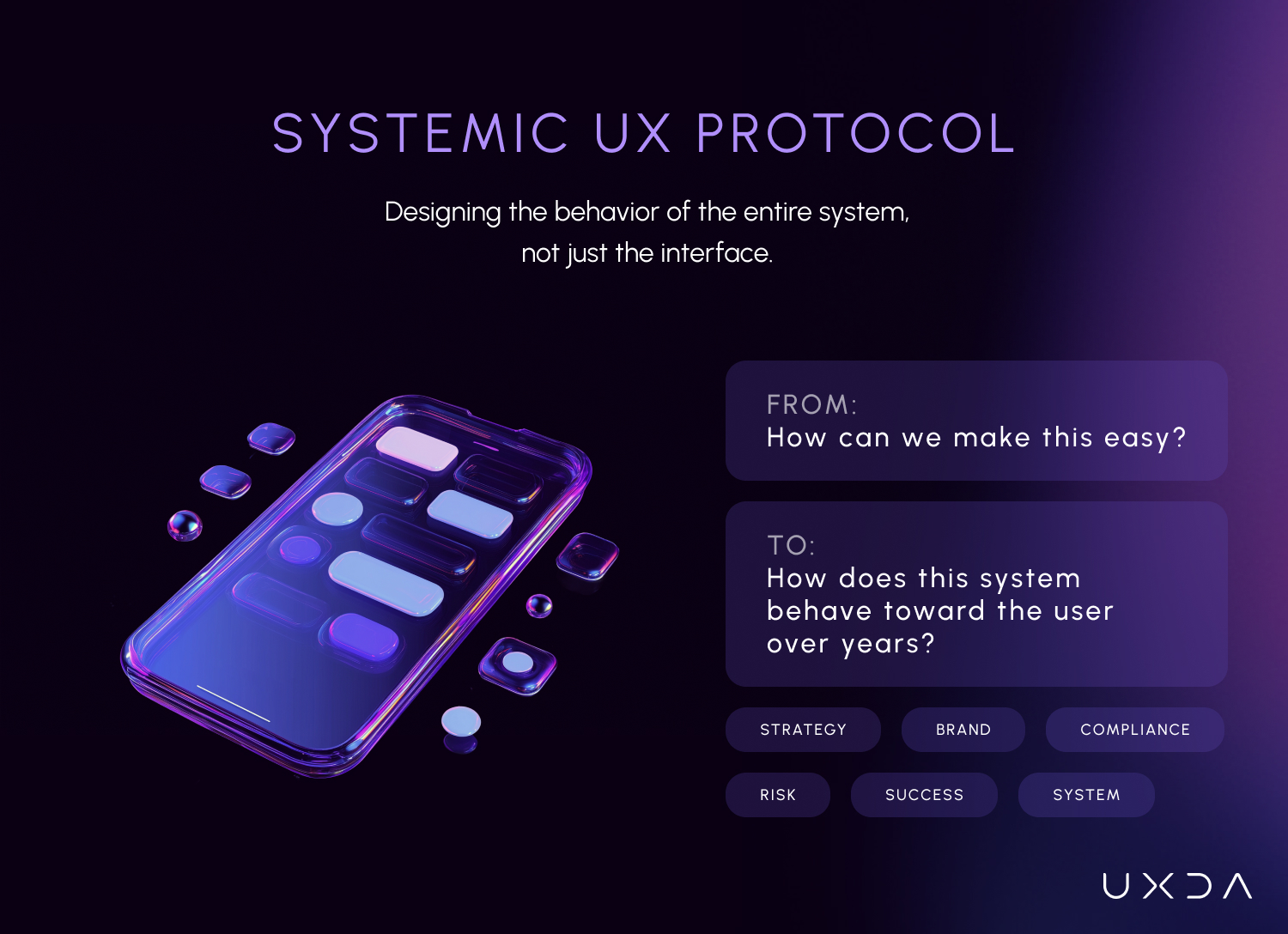
The difference is profound. One optimizes the interface, and the other optimizes the interaction between the user and the product at a system level. The systemic approach doesn’t replace good interface design—it builds upon it, expanding the designer’s focus from isolated moments to the complete user relationship.
1. UX Enters After Strategic Decisions Are Already Made
The most fundamental failure of traditional UX in banking and financial services is not methodological—it is positional. UX is treated as a service function that executes requirements and improves digital product interfaces after decisions have already been made. It is invited in once a direction is set, the scope is fixed, and constraints are locked. But in financial organizations, experience is not an outcome of strategy—it is one of the primary ways strategy is executed and controlled. How risk is communicated, how responsibility is shared, how trust is built, how behavior is guided—these are not design details; they are strategic layers.
Traditional UX tends to be tactical and reactive. It addresses immediate pain points. For example, “Users aren’t clicking the CTA; let’s make the button bigger or change the copy.” It often fixes symptoms as they arise (e.g., usability issues, confusing labels, low conversion steps).
Systemic UX is strategic and proactive. It aims to prevent problems before they start by understanding the root causes. Rather than asking, “Why aren’t users clicking this?” systemic designers ask, “Why did users reach a point of hesitation in the first place, and how can we re-architect the experience to avoid that doubt?” The focus shifts from local optimizations to global effects. For example, instead of just boosting the click rate on a feature, a systemic approach might realize the feature itself causes user anxiety and find a way to eliminate the anxiety and not just tweak the UI.
When UX is positioned as downstream execution instead of upstream control, banks lose their ability to steer customer behavior intentionally. Sysyemic UX treats experience and design as a large-scale control and execution system that shapes decisions, mitigates risk, enforces values and translates digital strategy into everyday behavior at scale. Without this shift, all UX improvements remain tactical, fragile and easily overridden.
Strategic UX defines the destination. Systemic UX designs how the experience system gets there. UX governance keeps the system moving in the intended direction.
2. UX Is Optimized Without Business and Risk Context
Traditional UX in banking is often driven by good intentions: reduce friction, increase engagement and simplify flows. But in financial organizations, these goals cannot exist in isolation. Every UX decision has implications for cost-to-serve, regulatory exposure, risk appetite and long-term value creation. When UX is designed without explicit connection to business strategy and processes, it becomes locally optimized and systemically expensive.
Features that increase engagement may increase support costs. Simplified flows may increase risk exposure. Well-intended improvements can directly contradict strategic priorities. Without strategic guardrails, UX turns into a collection of disconnected optimizations instead of a coherent value system aligned with how the financial institution actually makes money and manages risk.
3. Brand Strategy Is Separated From Digital Product Behavior
In many banks and financial organizations, brand is treated as a marketing asset while UX is treated as a product discipline. Campaigns promise care, stability, transparency or premium service, yet digital products behave in generic, mechanical ways. The result is a silent contradiction. The brand sounds human, but the app feels cold. The brand claims trust, but the digital experience feels defensive.
Traditional UX often sees brand as a decoration—colors guide, typography, tone of voice—rather than as a behavioral contract. In banking, the brand is not what you say. It is how the system behaves under pressure. When digital experiences fail to embody the bank’s identity and value proposition, the strongest brand promise disappears the moment the user opens the app.
Digital Brand Identity connects brand strategy with product behavior. It translates the financial institution’s positioning, personality and promise into the way digital services communicate, guide decisions, respond to uncertainty, personalize interactions and behave when something goes wrong.
A bank promising simplicity but exposing customers to fragmented terminology has a Digital Brand Identity problem. A bank promising empowerment while hiding important consequences behind complex product logic has the same problem.
Systemic UX ensures Digital Brand Identity is expressed through the wider experience system—not merely through visual styling.
4. Teams Lack a Shared Banking Experience Strategy
In large financial organizations, UX rarely fails because of disagreement among teams. It fails because there is no shared experience logic guiding decisions. Business, compliance, risk, product, marketing, development and design each optimize for their own objectives, revisiting the same decisions again and again. Redesigns happen frequently, but nothing fundamentally changes.
Traditional UX treats alignment as a communication problem, solved through workshops and documentation. In reality, it is a decision-system problem. Without a shared definition of what the experience is meant to achieve, every trade-off becomes a debate, and every roadmap becomes unstable. Hence, UX design becomes a short-term project instead of an operating system.
5. UX Produces Deliverables Without Shared Decision Logic
Traditional UX is very good at producing insights, wireframes, prototypes and features. What it often fails to produce is clarity about how product decisions should be made when priorities conflict. When speed conflicts with safety, when conversion conflicts with trust and when growth conflicts with responsibility, teams fall back on opinions and politics.
For example, in traditional workflows, teams often build feature after feature—designing and testing each new screen or function in isolation. The mindset is feature → screen → usability test → iterate. Not enough attention is given to how these features interrelate or what behavior emerges from their combination. Systemic UX treats connections and interactions over time as first-class design elements.
When adding or changing a feature, systemic designers ask: How will this affect other features? How will it shape user behavior, not just today but after weeks or months of use? What are the impacts on customer support? On churn rates? On user trust and brand perception? On compliance or risk? In this view, UX design becomes the engineering of relationships and dynamics systems, not just the drawing of screens. It’s about designing the behavior of the system.
Traditional UX knowledge exists, but it does not govern systemic behavior. Over time, decisions drift away from original intent. A systemic UX approach turns experience intent into decision rules that guide trade-offs consistently across teams and over time. Without this, even a strong UX stack slowly erodes as the organization scales.
6. UX Measures Immediate Interaction Instead of Long-Term Outcomes
Traditional UX optimizes for what is easy to measure: conversion, activation, task speed and immediate success rates. On paper, this looks efficient. In reality, it creates long-term damage. Banks that adopt this approach later wonder why churn increases, support costs explode, complaints grow, and non-performing loans rise. The issue is not that UX failed, but that UX impact was measured at the wrong time horizon.
A successful banking experience cannot be evaluated in a single session. It must be measured across the full customer journey—entry, daily usage, moments of stress and recovery after mistakes. When UX is judged too early, it optimizes short-term wins while creating long-term losses.
7. Task Completion Is Optimized Without Financial Consequences
Most traditional UX in banking focuses on the moment of interaction. Can the user complete the task? Is it fast? Is it clear? Success is defined by whether the task ends without friction, but the real impact of financial decisions does not happen on the screen. It happens months or even years later.
A credit taken today becomes stress later. An investment made today becomes panic during a market drawdown. A mistaken payment results in anxiety and loss of control. An unpaid bill results in penalties. Excessive spending quietly leads to shortage. Traditional UX celebrates completion. Banking reality lives in consequences, uncertainty and long-term financial risks.
A traditional UX mindset often just “treats the symptom.” If there’s low conversion, high drop-off or user confusion, the response is to tweak the UI element causing friction (e.g., simplify text, add a tooltip, insert a progress bar, etc.).
These can be valid fixes, but they might only mask deeper issues. That's why the most complex services have the largest instructions. Systemic UX digs into root causes behind user behaviors. Is a low conversion really due to a confusing screen, or is it because the user fundamentally distrusts something about the process? Is a high drop-off rate a UI issue, or does it indicate cognitive overload or misaligned incentives?
Systemic designers address problems like cognitive overload, conflicting user motivations, lack of trust, poor choice architecture or a disconnect between what the product promised and what it delivers. A Digital Banking Experience Disconnect is often the customer-facing symptom of a systemic problem. Channels contradict each other because systems, teams and rules behind them are disconnected. Systemic UX works upstream to identify and address those relationships rather than treating every inconsistency as an isolated interface defect.
System-driven UX focuses on the entire ecosystem of interactions. The question isn’t just “Can the user complete this task easily?” but “How does the business ecosystem as a whole behave toward the user, the market and within its context?”
8. Designs Happy Paths Instead of Failure and Recovery
In traditional UX thinking, errors are treated as edge cases. They are assumed to be rare, handled with generic messages and a fallback to support. But in financial services, errors are not exceptions—they are the experience. Fraud blocks are normal. Cross-bank transfers are delayed. Transactions remain pending. Verification fails. Limits are exceeded. Uncertainty is constant.
When these moments are not designed as first-class experiences, trust collapses instantly. A perfect success flow cannot compensate for a single poorly handled failure when money is involved. In banking, the error screen often matters more than the success screen.
Traditional UX often fixates on the here and now—the first-time use, the immediate session. Success is measured by task completion today. Systemic UX builds in time as a key dimension of design. It considers the user’s entire journey: onboarding → ongoing use → moments of error or crisis → recovery → long-term habit formation and retention.
A systemic approach will deliberately design for future scenarios—the first week of use, the first time something goes wrong, the moment a user contemplates quitting the service and even the conditions under which they return. It’s not just about designing a “happy path” but designing resilience and trust into the experience over time.
9. Internal Complexity Is Transferred to Customers
If you read most banking interfaces carefully, a pattern appears: “Invalid input.” “Operation failed.” “Try again later.” The language may be neutral, but the message is clear: the user is at fault. Traditional e-commerce UX assumes responsibility ends once instructions are clear. But when people’s finances are involved, this approach destroys confidence.
Users do not want to feel blamed when money is delayed, blocked or lost. A financial system must take responsibility by design—by explaining what happened, why it happened, what will happen next and how the user is protected. When UX shifts responsibility onto the user, trust breaks forever at the most critical moments.
10. UX Stops at Launch Instead of Managing Experience Over Time
The output of traditional UX efforts is typically a more usable interface—cleaner layout, smoother flows, higher immediate conversion or satisfaction scores. These are valuable, but often fragile wins. A nicely designed app can still fail if it doesn’t fit into users’ lives or if it ends up breaking their trust later.
Often, traditional UX treats a digital product launch as the finish line. After delivery, experiences are left to evolve through incremental changes, urgent fixes and new features. Over time, consistency breaks down, brand weakens, and digital complexity grows. Redesigns are triggered not by strategy shifts, but by accumulated incoherence.
In banking and financial services, where trust is built through consistency over years, this decay is costly. Without governance and ongoing calibration, UX value leaks silently. Systemic UX recognizes that experience is a living system that must be protected, measured and recalibrated continuously week-by-week—not redesigned every five years from scratch.
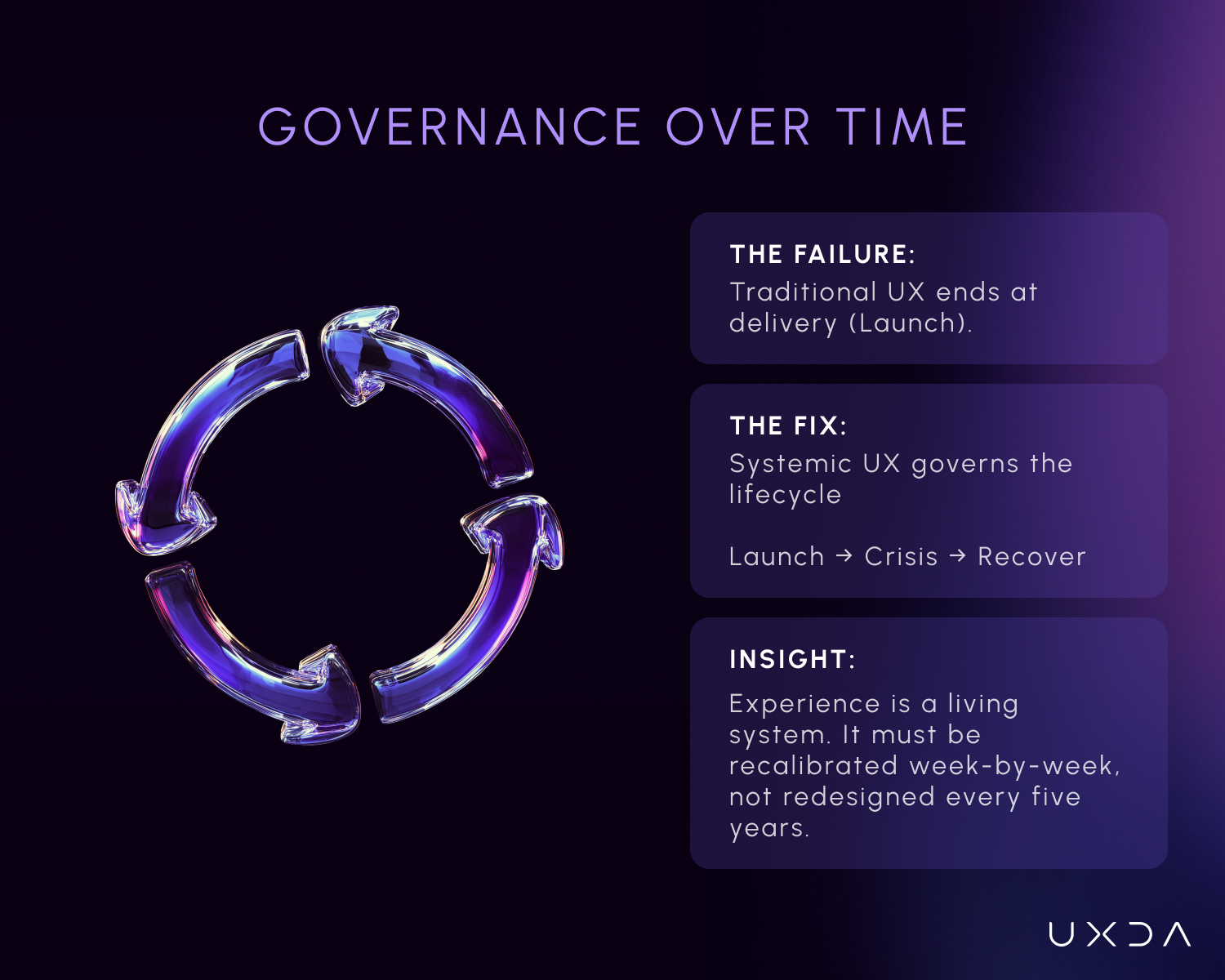
The outcome of systemic UX is a sustainable, constantly upgraded product. It means higher user trust and loyalty because you designed with transparency and empathy from the start and keep feedback loop post-launch. It means constantly avoiding hidden “UX debt”—those design shortcomings that quietly undermine metrics until they become crises.
Ultimately, a systemic approach to UX design aims for predictable growth in real business metrics (e.g., retention, lifetime value, lower support burden, etc.) by ensuring the product and the user are on the same side over the long run, not at odds.
What Is Systems Thinking in Financial UX Design?
Systems thinking in financial UX examines how different elements of an experience interact and produce outcomes together rather than analyzing each element independently. In banking, those elements can include interfaces, products, pricing, risk rules, policies, technology, customer support, communications, employee workflows and organizational incentives.
Systemic UX applies this thinking specifically to experience design. Instead of asking only whether each touchpoint works, it examines the relationships, feedback loops, delays and structural constraints that determine how the overall financial experience behaves.
Systemic UX shifts the focus from individual screens or features to the entire ecosystem in which a financial product operates—users, technology, policies, processes and organizational decisions. Rather than fixing surface-level usability issues, it addresses the upstream structures that shape behavior, risk and trust over time.
Unlike traditional UX, which optimizes isolated touchpoints, systemic UX designs for how the whole system behaves under real conditions, including scale, failure and change. It shapes the system's behavior across states and time, rather than just how a screen is structured. This approach is essential in complex domains such as finance, where experience outcomes are driven as much by internal logic and governance as by interface quality.
We have the following key principles of systemic UX in financial services:
Design the Whole Experience, Not Isolated Parts
Digital experience is a system, not a screen. You can’t understand a system by optimizing individual components in isolation. A financial experience is shaped by brand perception, cross-channel digital communication, usability consistency, overall visual language, range of features and usability, policies, risk rules, disclosures, support processes, pricing, tone of voice, etc.—not the user interface alone. Optimizing interfaces without aligning the system creates false clarity.
Treat Every Experience Decision as Interconnected
Actions in one part of the system ripple elsewhere, often in unexpected ways. Cause and effect are rarely linear or immediate. Every design decision has risk and trust consequences, and even small changes can create global improvements or global problems. Changes to flows, defaults, limits or messaging alter customer behavior—and therefore financial risk, support load and trust levels—often weeks or months later.
Design Relationships Between Products, Rules and Journeys
What matters most is not the components themselves, but how they interact, reinforce or constrain one other. Relationships matter more than features, because what customers experience in financial services is the relationship between product logic, communication and consequences over time—not isolated features or journeys.
Use Feedback Loops to Shape Customer Behavior
Systems are shaped by reinforcing loops (that amplify outcomes) and balancing loops (that stabilize or resist change). Ignoring feedback leads to recurring failures. Poorly designed alerts, limits or error handling train customers to panic, overload support or disengage. Well-designed feedback builds confidence and self-regulation in self-serve digital financial products.
Design for Delayed Financial Consequences
Effects often appear long after decisions are made. Short-term success can hide long-term damage. In finance, consequences surface after the interaction: fees, rejections, investment losses, budget deficits or compliance events. UX must anticipate these delayed moments, not just the point of action.
Change Structures That Produce Poor Experiences
System behavior is largely a product of underlying structures—rules, incentives, flows and constraints—not individual intent or effort. Legacy operating systems, bureaucratic protocols, legal procedures, approval logic and compliance constraints often define the real experience in finance. If these are misaligned, no amount of visual polish can fix the outcome.
Optimize the System, Not Departmental Silos
Improving one function, metric or team can degrade overall performance if system-level goals aren’t aligned. When channels, products or teams in financial institutions optimize independently, customers experience friction, inconsistency, contradictions, confusion and loss of trust—especially in key moments of stress.
Find Experience Leverage Points
Well-placed interventions at leverage points can reshape the entire system, while large efforts in the wrong place do nothing. Small changes in defaults, framing, timing or responsibility-sharing can dramatically reduce risk and increase trust—far more than superficial UI redesigns.
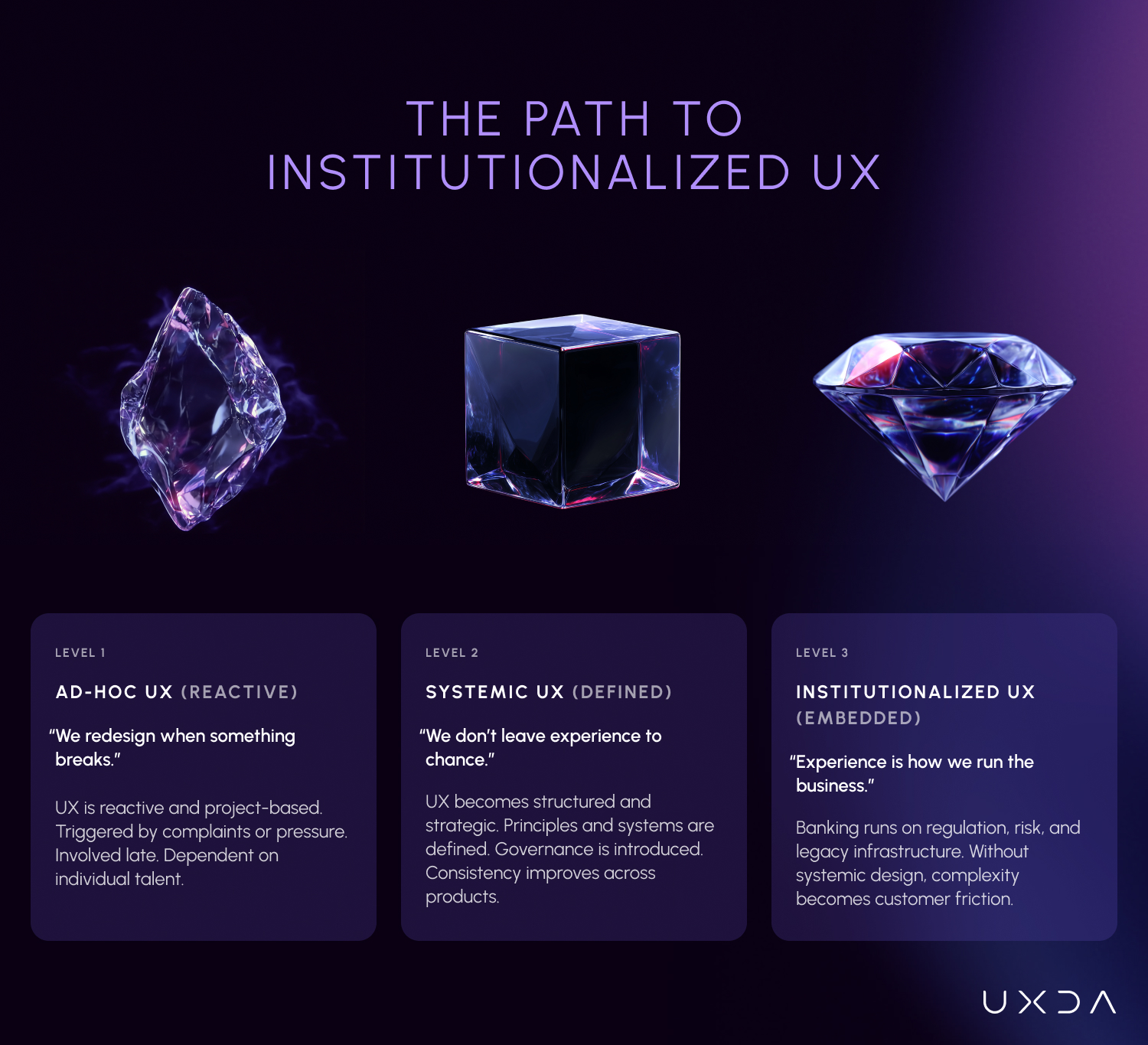
UX Maturity Model: Financial Institutions’ Path to Institutionalized User Experience
As we stated previously, in banking, user experience is not a matter of convenience. It shapes how customers perceive risk, decide under uncertainty and place long-term trust in institutions. A single unclear interaction can trigger panic and support escalation, reputational damage or regulatory scrutiny long after the moment of use.
Yet most financial institutions still treat UX as a downstream delivery activity—applied after strategy, compliance and technology decisions are already fixed. This creates a structural gap: interfaces improve, but the system governing customer behavior remains unchanged.
UX maturity determines whether an experience is reactive or controlled, dependent on individuals or embedded institutionally, optimized for short-term metrics or long-term trust. When product teams repeatedly make local compromises without considering their system-wide effects, Experience Debt accumulates: inconsistent journeys, duplicated logic, exceptions, unclear communication and operational workarounds that become increasingly expensive to correct.
UXDA does not treat UX maturity as a design evolution. It treats it as a systemic transformation. Through the DXG system (Digital Experience Governance), UXDA connects business strategy, brand values and digital experience behavior—how customers are guided, informed, protected and supported in real financial moments.
The objective is not to replace existing processes, but to embed experience logic into how financial institutions already operate—across product, risk, compliance, operations and leadership. The outcome is not better design maturity, but institutional experience maturity.
Matured UX in financial institutions is not a one-time redesign project. It is an ongoing value management and control system.
Level 1 — Tactical UX
“We improve individual journeys.”
UX exists as a reactive intervention. Design work is triggered by complaints, declining metrics, competitive pressure or rebranding initiatives. UX teams are execution-focused and invited late, once strategy, scope and constraints are already fixed. Experience quality depends on individual talent, not institutional rules.
How UX Shows Up
- One-off redesign projects
- Usability testing at the end of delivery
- UX success measured by UI clarity or task completion
- UX seen as a cost or cosmetic improvement
What Really Happens
- Each product optimizes locally
- Inconsistencies multiply across channels
- Risk is “disclosed,” not understood
- Trust issues appear months after launch
Hidden Risk
Experience debt accumulates silently. Problems surface only when customers panic, churn or escalate.
Level 2—Systemic UX
“We manage experience as an interconnected system.”
UX is recognized as a strategic and systemic discipline, not just an interface design service. The organization introduces experience principles, review mechanisms and shared standards. UX begins to influence decisions earlier—though not yet consistently across the institution. Governance exists, but it is still partially dependent on people and projects.
A Design System standardizes reusable UI components, patterns and visual rules. Systemic UX addresses the much wider set of structures that influence experience: product logic, policies, pricing, risk, content, operations, customer support, technology and organizational decisions. A Design System can create interface consistency. It cannot by itself create institutional experience coherence.
How UX Shows Up
- Overall UX strategy
- Defined experience principles and design systems
- Regular UX evaluations and reviews
- UX involvement in product planning
- Cross-team alignment on UX
- UX consistency across the digital ecosystem
What Changes
- Subjective design debates become structured discussions
- Obvious experience risks are identified earlier
- Consistency increases across products
- UX starts speaking the language of business and risk
Structural Limitation
Systemic UX governance often exists around the organization, not inside it. When priorities shift or key people leave, digital experience quality can still drift.
Level 3—Institutional UX Governance
“Experience is embedded into institutional decision-making.”
UX is embedded as a control system within the organization. Digital experience priorities and principles are non-negotiable. Decision frameworks are formalized. UX accountability is distributed across roles—product, risk, compliance, content, support and leadership. UX no longer depends on individual teams; the system enforces itself.
At this level, Systemic UX becomes institutionalized through Systemic UX Governance—the organizational capability that maintains experience principles, accountability and measurement across products and teams.
How UX Shows Up
- UX mandate aligned with business, brand and risk strategy
- Experience reviews integrated into governance processes
- Clear UX accountability at executive and operational levels
- Continuous experience health monitoring
- External partners act as auditors and stewards, not just executing vendors
What Becomes Possible
- Trust scales across products and channels
- Digital experience remains stable during growth, crises and change
- Redesigns become controlled evolution, not emergency fixes
- UX outlives teams, vendors and technologies
Strategic Advantage
The institution does not just design better experiences. It prevents bad experiences from being created.
Example: Payment Failure Through a Systemic UX Lens
Visible customer problem:
“The transfer failed.”
Traditional interface response:
Improve the error message.
Systemic UX diagnosis:
- Why did the transaction fail?
- Does the customer understand the reason?
- Do transaction history and notifications show the same state?
- Does customer support see the same information?
- Can the customer recover without retrying incorrectly?
- Does the fraud or limit rule create repeated false failures?
- What behavior does the failure teach customers?
The error message may still need improvement, but Systemic UX prevents the interface from becoming the place where structural problems are merely explained rather than solved.
How to Apply Systemic UX in Banking
The purpose is not to make every UX initiative larger. It is to make sure teams solve problems at the level where those problems are actually created.
1. Define the Customer and Business Outcome
Start with the outcome rather than the feature or screen.
2. Map the Experience System
Identify journeys, products, policies, data, technology, support, risk and ownership influencing the outcome.
3. Find Root Causes Behind Visible UX Problems
Distinguish interface friction from structural problems.
4. Identify High-Leverage Experience Changes
Prioritize changes capable of improving several journeys or metrics simultaneously.
5. Design for Success, Failure and Recovery
Treat uncertainty and exceptions as core banking experiences.
6. Measure System-Level Outcomes
Connect usability with trust, support demand, risk, retention and business value.
7. Govern the Experience Continuously
Use shared principles, decision rights and measurement to prevent fragmentation from returning.
Conclusion: From Banking UX Design to Systemic Experience Management
Traditional Banking UX Design remains essential. Financial products still need intuitive interfaces, understandable information and usable journeys. But those qualities address only the visible layer of a much larger experience system.
In financial services, customer outcomes are also shaped by product rules, risk decisions, technology, communications, support, operations, brand behavior and the consequences that emerge after an interaction ends. When these elements are optimized independently, even well-designed screens can become part of a fragmented experience.
Systemic UX expands the unit of design from the interface to the relationships that make the financial experience work. It connects customer needs with business strategy, risk, Digital Brand Identity, products, processes and technology so that local decisions contribute to one coherent customer relationship.
Strategic UX defines the experience the institution wants to create. Systemic UX translates that intent into an interconnected experience architecture. Systemic UX Governance ensures that the architecture remains coherent as products, teams, technologies and regulations evolve.
The objective is to solve experience problems at the level where they are actually created. In complex financial services, the strongest UX is a system designed to behave coherently over time.
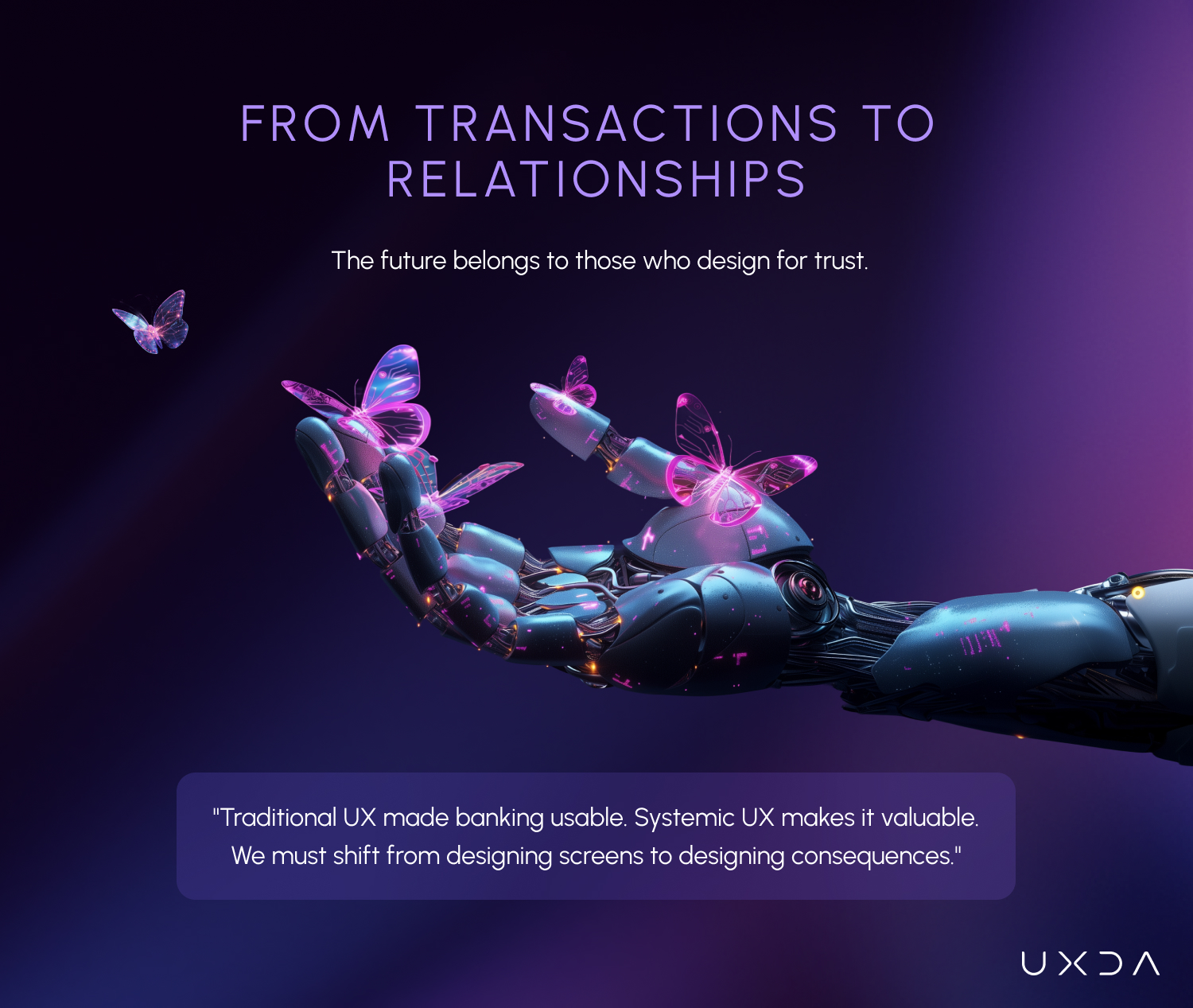
Digital financial services are about trust over time. And trust isn’t built by a single screen or a one-off delight moment. It’s built by an entire system consistently behaving as one Bank-as-a-Product in the customer’s best interest, even (and especially) when things go wrong.
Bank-as-a-Product is an institutional model that treats the entire bank as one continuously evolving customer experience rather than a portfolio of disconnected products and projects. Systemic UX is the design methodology that helps make that model actionable. It reveals how accounts, payments, cards, lending, investments, communications, support, operations and AI interactions affect one another so that teams can design the banking relationship as a coherent system.
What financial services needs is a shift from designing screens to designing behavior. From “making it easy to do” to “making it safe to decide.” From single-touchpoint improvements to a continuously governed experience system that aligns product, risk, brand promise, support and long-term customer outcomes.
If traditional UX made banking and other financial services apps usable, systemic UX makes financial services valuable—as in valued by users as their go-to financial partner. The future of financial UX will be won by those who design relationships, not just interfaces. And that means thinking systemically, acting holistically and always, always considering the human on the other side of the screen as a partner in a long-term brand journey.
That requires institutionalizing a systemic approach—not as a one-off project, but as an operating model: a shared experience logic that guides trade-offs, shapes responsibility, designs for uncertainty and protects consistency as the organization evolves. Because in modern financial services, digital experience is not a layer on top of strategy. It is the strategy in action— every day, at scale.
Systemic UX in Banking and Financial Services: Key Questions
What is Systemic UX in banking?
Systemic UX is an approach to financial experience design that looks beyond individual screens and features to the entire system shaping customer outcomes. It considers how customer behavior, business strategy, risk, technology, policies, processes, Digital Brand Identity and organizational decisions interact over time.
Why is traditional UX not enough for banking and financial services?
Traditional UX is effective at improving usability, clarity, speed and task completion, but financial experiences involve additional factors such as risk, uncertainty, trust, delayed consequences and regulatory constraints. A journey can therefore be easy to complete while still creating poor customer or business outcomes later.
What is the difference between traditional UX and Systemic UX?
Traditional UX often asks how to make a particular screen or journey easier to use. Systemic UX asks how the entire financial system should behave toward customers and the business over time, including what happens before, during and after an interaction and how one experience decision affects other parts of the ecosystem.
Why are financial products different from typical digital products?
Financial decisions often involve money, uncertainty, emotional stress, asymmetric information and consequences that may appear months or years later. Customers may complete a loan, investment or payment successfully in the interface while experiencing financial stress, regret or loss of trust afterwards, so immediate task completion alone cannot define UX success.
Why does Systemic UX focus on consequences rather than only task completion?
In finance, the real impact of a decision often occurs after the screen interaction ends. Systemic UX therefore considers how product decisions influence later customer behavior, financial outcomes, trust, support demand, retention and risk rather than optimizing only the moment of conversion.
How does Systemic UX help banks build customer trust?
Systemic UX treats trust as an outcome of how the entire service behaves, especially when something goes wrong. Clear explanations, transparent rules, predictable feedback, appropriate responsibility-sharing and well-designed recovery experiences can help customers maintain confidence during moments of uncertainty or stress.
Why should banks design failure and uncertainty as core UX scenarios?
Failed verification, delayed transfers, fraud blocks, exceeded limits and pending transactions are normal parts of financial services, not rare edge cases. Designing these moments explicitly helps customers understand what happened, what will happen next and what they can do, reducing panic, support escalation and loss of trust.
How does Systemic UX connect banking UX with business strategy and risk?
Every financial UX decision can affect more than customer convenience. Simplifying a journey may influence conversion, cost-to-serve, regulatory exposure, risk or long-term customer value. Systemic UX connects experience decisions with these broader business consequences so that local UX improvements do not create system-level problems.
Why does Digital Brand Identity matter in Systemic UX?
A bank’s brand promise becomes meaningful only when customers experience it through product behavior. If a financial institution promises simplicity, transparency or premium service but its digital journeys feel confusing, defensive or generic, the Digital Brand Identity breaks down. Systemic UX connects brand intent with how the financial service actually behaves.
How do feedback loops affect banking UX?
Customer behavior is shaped by repeated feedback from the financial system. Poor alerts, confusing limits or unclear error handling can train customers to panic, disengage or depend on support, while well-designed feedback can reinforce confidence, understanding and self-service behavior over time.
Why can optimizing one banking journey make the overall experience worse?
Products, channels and teams in a financial institution are interconnected. Improving conversion, speed or engagement in one area can increase support demand, risk, complexity or inconsistency elsewhere. Systemic UX evaluates these relationships before optimizing an isolated metric or journey.
What role does UX maturity play in Systemic UX?
UX maturity determines whether experience quality depends on individual designers and occasional redesigns or is embedded institutionally. More mature financial organizations connect UX with strategy, risk, operations, governance and long-term customer outcomes instead of treating it primarily as downstream interface production.
Why does Systemic UX require governance?
Financial experiences continuously evolve through new products, regulations, technologies, vendors and team decisions. Without shared principles and decision rules, the experience gradually fragments. Governance helps preserve strategic intent, Digital Brand Identity, trust and coherence as the institution changes over time.
Does Systemic UX replace traditional UX methods?
No. Usability research, interaction design, prototyping and interface optimization remain essential. Systemic UX builds on these methods by expanding the scope from individual interactions to the relationships, structures, feedback loops and long-term consequences that determine whether the overall financial experience succeeds.
How can banks start applying Systemic UX?
Banks can begin by looking beyond isolated screens and mapping the broader experience system: customer needs, journeys, business objectives, risk rules, technology constraints, support processes and organizational ownership. They can then identify root causes and leverage points where experience changes can improve multiple customer and business outcomes instead of repeatedly treating individual symptoms.
What is Banking UX Design?
Banking UX Design is the process of designing how customers understand, navigate and interact with banking products and services. It includes customer research, information architecture, interaction design, content, accessibility, behavioral design and visual hierarchy across mobile banking, online banking and other digital channels. Systemic UX expands this scope by examining the wider product, operational and organizational system that determines how those individual interactions behave together.
What is Financial UX Design?
Financial UX Design is the specialized discipline of designing digital experiences for banking, FinTech, investment, trading, insurance and other financial services. It combines core UX principles with the specific challenges of finance, including regulation, risk, trust, data complexity, emotional pressure and high-consequence decision-making. Systemic UX is one methodology within Financial UX Design that focuses on the relationships between those elements rather than individual interfaces alone.
How does Systemic UX improve digital banking user experience?
Systemic UX improves digital banking user experience by addressing the structures behind recurring customer friction instead of repeatedly optimizing isolated screens. It connects product logic, channels, policies, communications, customer support, technology and operations so customers encounter fewer contradictions, clearer journeys and more predictable service behavior across the wider banking relationship.
What is systems thinking in UX?
Systems thinking in UX is an approach that examines how different parts of an experience interact and produce outcomes together rather than evaluating each part independently. In financial services, this can include interfaces, products, pricing, risk rules, policies, technology, customer support and organizational incentives. Systemic UX applies systems thinking to experience design so teams can identify feedback loops, dependencies and root causes behind customer problems.
Is Systemic UX the same as a Design System?
No. A Design System standardizes reusable UI components, visual rules and interaction patterns, while Systemic UX addresses the wider system that shapes customer experience. This includes product logic, policies, processes, communication, service behavior, technology constraints and organizational decisions that cannot be solved through interface components alone. A Design System can support Systemic UX, but it cannot replace it.
Discover our clients' next-gen financial products & UX transformations in UXDA's latest showreel:
UXDA partners with banks and financial institutions to identify the systemic causes behind fragmented digital experiences. Through Strategic UX, Systemic UX, Digital Brand Identity and experience governance, we connect customer needs with business strategy, product decisions, risk, technology and operations—helping financial organizations improve experience quality at scale rather than repeatedly redesigning individual screens.
- E-mail us at info@theuxda.com
- Chat with us in Whatsapp
- Send a direct message to UXDA's CEO Alex Kreger on Linkedin