


Every bank I talk to has doubled its investment in digital technology and especially AI. Hiring talents. Shipping features. Tracking metrics. Implementing AI in banking services and deploying new digital products. AI accelerates digital banking transformation. But what if the bank automates the solution to the wrong problem? When the underlying problem is misdiagnosis, acceleration isn’t progress—it only scales the failure. It won't be pleasant, after investing millions in AI, to hear shareholders ask: “Why hasn't AI improved our banking customer experience?”
AI implementation in banking is the process of applying artificial intelligence to banking operations, customer journeys, decision-making and digital experiences to automate processes, personalize services and improve customer and business outcomes. But successful AI implementation depends on more than technology. Before automating a journey, banks need to be certain they are solving the right customer problem.
Successful implementation, however, depends on identifying the right problem before selecting the AI solution. AI can automate an existing process or optimize an existing customer journey, but it cannot guarantee that the process itself should exist or that the bank has correctly understood the customer need behind it. This makes UX research and customer problem diagnosis an important part of AI implementation in banking—particularly when AI is applied directly to customer-facing experiences.
In 2026, banks are no longer debating whether to deploy AI in their digital experience. They are debating speed. JPMorgan, Bank of America and dozens of regional institutions are integrating AI co-pilots, agentic flows and personalization engines into the core of their digital products. The investment is real. The urgency is real.
But there is a specific risk no one in the boardroom is naming: AI doesn’t question assumptions; it scales them.
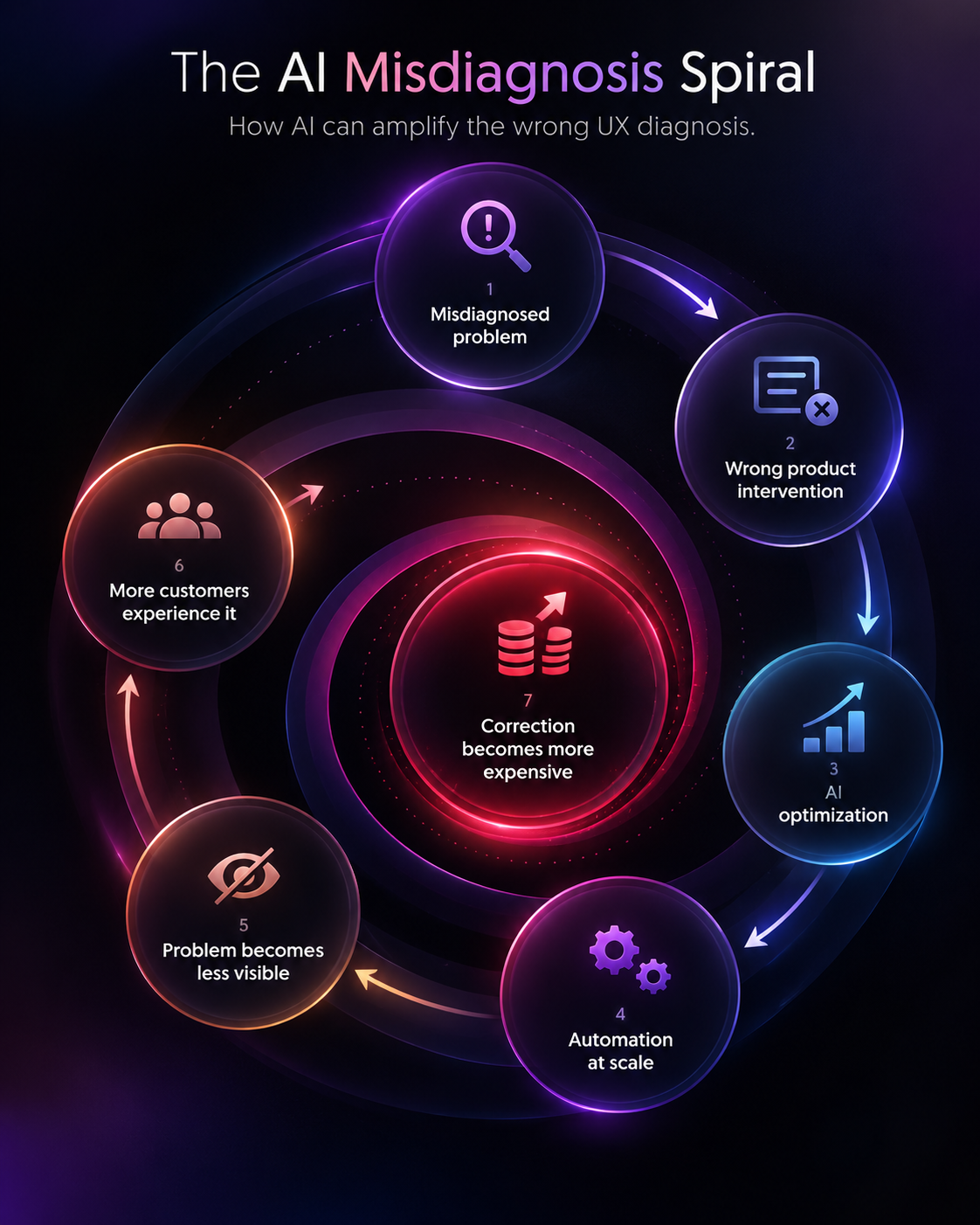
When a digital banking experience is built on a misdiagnosed problem—a flow that exists for internal reasons rather than customer ones, a drop-off point explained by a story the team has told itself long enough to mistake for fact—AI doesn’t fix that. It learns from it. It optimizes it. It automates it at a speed and scale that makes the underlying error invisible and the cost of correcting it exponentially higher.
This is not a technology problem. It’s a perspective problem. And it’s about to become the defining competitive gap in digital financial services.
Customer Experience Challenges of AI Implementation in Banking
Most banking executives operate from a reasonable belief: if something is broken or weak in their digital product, their internal team will eventually find and fix it. Their team knows the systems. They understand compliance. They track the metrics. Why wouldn't a $200K-per-head internal team solve it?
When a team truly understands a problem, they already have the capacity to solve it. If progress stalls—user adoption plateaus, conversion rates stagnate or customer complaints repeat, when digital adoption lags years behind the market—the issue is almost never lack of effort, speed or innovations. In-house teams suffer from "Institutional Stockholm Syndrome." They will not magically fix the problem, because they are the problem.
And, unfortunately, huge investments in AI, innovation, copying competitors, following trends, poaching talent and acquiring Fintech companies don't really help. I've seen this hundreds of times.
Speed and horsepower don’t fix direction, because AI optimizes what exists.
Banks are not underinvesting. They are misinvesting—and with increasing precision. And the upcoming AI revolution will only exacerbate this, not resolve it. Because AI doesn’t fix flawed thinking; it industrializes it. Actually, AI will pour rocket fuel on your dumpster fire.
Everyone names outdated digital legacy as the main limitation for UX improvement. But what if legacy stack is a convenient excuse for a lack of courage to research and transform customer experience?
Across the 150 digital experience transformation projects we've implemented in 39 countries— from banks in the Middle East and Africa to Tier 1 institutions in Europe and the US—we see that the right solution is always structurally close. Overcoming the barrier is never about huge resources. It always starts with the right diagnosis.
One of the most overlooked challenges of AI implementation in banking is that automation can scale an incorrectly understood customer problem.
It's not just technical debt or the siloed team that is so common in financial organizations. It’s because the problem is being misunderstood. It is a misdiagnosis that feels, from the inside, like a correct one. A door that once opened but today has become a bottleneck.
Einstein’s observation holds here with uncomfortable precision: “We cannot solve our problems with the same thinking we used when we created them.” In modern terms: the mental model that built your digital service is the same one preventing it from evolving.
This is the architecture of the blind spot. Not ignorance. Not laziness. But a confident, internally coherent explanation for a problem with your digital service. Explanation that is subtly, consequentially wrong.
What Is UX Misdiagnosis in Banking AI Implementation
Most leaders double down on execution and technology when performance stalls. The reasoning is understandable: your team knows the systems, understands compliance and has institutional continuity.
All true. But none of these guarantee clarity. In fact, they reinforce the blind spot. That’s like pressing the accelerator when the map is wrong.
There is a specific overconfidence that comes from deep familiarity: the certainty that understanding the system means understanding its failure. Expert judgment research is consistent on this point: it is one of the most reliable mechanisms by which intelligent, experienced people remain wrong for extended periods. They are not guessing. They have a model. But the model is the problem.
The question is not whether your team is capable implement AI in banking the right way. The question is whether any team, operating from inside the same assumptions that generated the problem, can reliably identify it.
Most banking institutions invest heavily in execution, technology, digital service and AI: building faster, deploying more, optimizing continuously. The execution is excellent. But the real leverage lies earlier—in UX diagnosis.
Bad UX is obvious. Misdiagnosed UX is invisible. Before asking “How do we improve this?” try to ask “Do we actually understand what’s wrong?”
That question sounds obvious. It is almost never asked with rigor, because answering it seriously requires entertaining the possibility that the team closest to the problem may be the least positioned to see it. If the answer is uncertain, more execution will only deepen the inefficiency.
The hidden risk of AI in banking isn't technology—it's misdiagnosis.
UX misdiagnosis in banking AI implementation occurs when a bank correctly identifies a visible symptom but incorrectly identifies the underlying customer problem causing it.
For example, a bank sees a 20% drop-off in digital onboarding and concludes that customers aren't prepared with the required documents, so AI needs to manage the process. UX research may reveal that the real problem is that customers don't understand why the documents are required and lose trust at that point in the journey.
If your digital metrics are not where they should be—and your team has a confident explanation for why—consider that the explanation itself may be the problem. Not the team. Not the budget. But the story that has been told about the data long enough to become invisible as a story. And if that’s the case, the solution is not more internal effort. It’s perspective.
Why Can AI Implementation in Banking Solve the Wrong Customer Problem
The bank’s in-house team genuinely understands the product better than any outsider. That is not in question. They know compliance edge cases, legacy dependencies, the political weight of every design decision, internal KPIs, strategic guidelines, brand values and organization culture principles. That knowledge is valuable, but is also the very thing preventing them from questioning the foundation.
Over the years, their constraints become invisible. Teams stopped seeing friction as friction. A flow that forces users through seven steps to complete what should take two stops registering as a problem, because everyone inside the organization has long since adapted to it.
Behavioral economists call this the availability heuristic: we assess what is normal based on what is familiar. When a bank's team has only ever seen the system from inside, “familiar” and “necessary” collapse into the same category. The twenty-step onboarding flow stops registering as friction because employees internally complete it easily.
The result is an organization optimizing the wrong thing with impressive dedication. Perfecting flows that are fundamentally broken. Shipping features that address internal product milestones instead of customer outcomes. Tracking CSAT scores that signal a problem without locating it. And the most reliable indicator that this dynamic has taken hold? The phrase “users just don’t understand the product yet.” This is spoken not as a question, but as a conclusion.
And AI implementation in banking will not correct this dynamic—it will accelerate it. When a flawed understanding of the problem is embedded into the system, AI doesn’t question it; it scales it. It learns from existing data, optimizes for existing metrics and reinforces existing assumptions. The same misdiagnosed flows become faster, more automated, more personalized—and more wrong.
A strong AI banking strategy should begin with customer and business problems rather than available technology or isolated AI use cases.
Most banks are already using GenAI to build chatbots that simply explain their broken processes more politely. But when a loan application is a 12-page nightmare, a "seamless AI interface" is just a digital lipstick on a pig. They aren't fixing the friction; they're just paying OpenAI or Anthropic to apologize for it in real-time.
What if instead of removing friction, AI will make it invisible, masking the signal that should have triggered a digital service redesign? In this way, the coming wave of AI deployment in digital banking carries a specific risk that no vendor deck addresses: institutions with unresolved blind spots risk widening the gap between themselves and truly customer-centric competitors. Not because they lack technology, but because they are using the most powerful technology to optimize the wrong reality.
AI implementation in banking will not fail in financial experience. It will scale the failure.
A research by McKinsey proves that companies focusing on customer experience grow revenues at twice the rate of their peers. But it happens when organizations redefine problems from the customer’s perspective and not their internal one.
This is not about capability or talent. The most dangerous version of this problem exists in institutions with excellent internal teams. The issue is structural.
1. Context lock-in
Internal teams inherit assumptions. What was once a decision becomes “how things work.” Every organization accumulates unexamined logic: what users want, what they can tolerate, what compliance demands, what the technology allows. These assumptions embed themselves in codebases and design systems and become invisible to the people who live inside them.
In practice, this looks like a loan application flow that routes customers through multiple steps that compliance accepted five years ago, but no one updated the product because the old flow still works. Or like in-app notification that triggers at the wrong behavioral moment because the trigger logic was built around a new feature launch calendar, not a customer decision model.
2. Incentive bias
They optimize for what they are measured on, not what matters. Incentive structures in large institutions reward delivery, not discovery. Teams are evaluated on features shipped, timelines met, budgets managed. None of these metrics ask whether the right problem is being solved.
In practice, this looks like a quarterly business review where drop-off rates and complaints are grouped, presented, discussed, assigned to a sprint and appear in the same slide next quarter—with a slightly different hypothesis each time, none of which questions whether the UX flow is correct.
3. Proximity blindness
The closer you are to the system, the harder it is to question its foundations. Internal teams face what Clayton Christensen identified as the core paradox of institutional innovation: the same expertise that makes an organization successful makes it structurally resistant to the questions that would allow it to evolve. Familiarity doesn’t just reduce objectivity; it eliminates it.
In practice, this looks like a product team that has A/B tested every button color, label and CTA position on a screen but has never asked whether the screen itself is solving the right problem. The testing infrastructure is sophisticated. The hypothesis it’s testing is wrong.
They’re not optimizing UX. They’re optimizing a misunderstanding.
Banks Can Diagnose Customer Problems Before Implementing AI
The blind spot is not abstract. It materializes in specific, recognizable patterns across every major product area in digital banking. Before introducing AI automation, personalization or conversational interfaces into a customer journey, banks should determine whether the underlying experience has been correctly diagnosed:
Onboarding: The identity verification flow contains 20 steps. Three of them exist because of a compliance interpretation from 2018 that has since been superseded, but the legal team signed off on the current version and no one has reopened the question. Conversion data shows a 20% drop-off at step four.
The internal hypothesis: customers don’t have their documents ready.
The actual problem: customers don’t understand why the step is necessary, and trust collapses at the point of document upload.
Cross-sell: The in-app loan offer appears after a product team prepared it and hits the button, not triggered by the actual lifetime event. The offer converts at 0.3%.
The internal hypothesis: customers aren’t ready for credit.
The actual problem: the bank is presenting the offer at the wrong moment.
Support: The complaint resolution flow routes customers through three handoffs before reaching a resolution owner. The architecture mirrors the bank’s internal org chart. Customers experience it as indifference.
The internal hypothesis: resolution times are within SLA.
The actual problem: SLA is being measured from the wrong starting point.
In each case, the team has an explanation and strict process. The explanation is fluent and consistent but wrong. And each case is now a candidate for AI-assisted optimization, —which will make the wrong explanation run faster and feel more inevitable.
You may be dealing with a misdiagnosed UX problem when:
- the team has a confident explanation but little supporting research;
- the same problem persists despite repeated optimization;
- A/B tests improve metrics without improving the overall journey;
- teams optimize individual screens instead of questioning the journey;
- product teams blame customers for low adoption;
- compliance or legacy systems are treated as unquestionable explanations;
- multiple teams propose different explanations for the same customer behavior;
- feature delivery increases but business outcomes remain flat;
- customer complaints repeat despite multiple fixes;
- AI is being deployed before the underlying journey has been validated.
When a genuinely independent perspective enters a complex system, its value is not superior knowledge. It is the ability to ask questions that stopped being asked years ago inside an organization.
- Why does this flow exist at all?
- Why is this step necessary for the user?
- What user problem does this flow actually solve?
- If we designed this from the customer’s experience backward, would it look anything like this?
These are not sophisticated questions. They are elementary ones. The reason they go unasked internally is not that the team is incapable of asking them—it is that the existing system has already, implicitly, answered them. The answers have been baked into the architecture.
The interventions that emerge from this kind of perspective shift are rarely incremental. We have seen onboarding conversion improve significantly, not by optimizing a broken flow but by removing entire steps that had never been challenged. The problem was not that the steps were slow. It was that they were unnecessary, and the internal team had stopped seeing them as a choice.
Think of it the way boards think about external auditors: not because internal finance teams are incompetent, but because accountability and proximity are structural disqualifiers from certain kinds of clarity. Experience governance requires the same logic. An independent diagnostic function—separate from the execution team, accountable to outcomes rather than delivery—is not a vendor relationship. It is a structural safeguard.
How can banks prepare customer journeys for AI implementation:
- Observe actual customer behavior
- Separate UX symptoms from root causes
- Challenge internal assumptions
- Conduct customer and UX research
- Validate the customer problem
- Apply AI to the validated opportunity
Final Question: How Can Banks Assess AI Readiness Before Implementation?
AI readiness in banking should include customer experience readiness, not only technology, data and infrastructure readiness. Before automating a customer journey, banks should understand why customers behave as they do, which friction points actually matter and which outcome AI is expected to improve.
Offer your team a 7-question diagnostic:
- Do we know why customers abandon our critical journeys?
- Are our explanations supported by research?
- Can we distinguish symptoms from root causes?
- Have we challenged the assumptions behind existing journeys?
- Are we measuring customer outcomes rather than feature delivery?
- Do we know which problems AI should solve?
- Are we automating validated experiences rather than existing processes?
Listen for the structure of the answers. If the answers revolve around assumptions rather than validated insights—if it sounds like a story the team has told itself for long enough that it has become indistinguishable from fact—you’ve found your blind spot.
Count the seconds before someone reframes it as a constraint—compliance, legacy systems, third-party dependencies. Those reframes are not wrong. But notice whether they’re treated as facts to work within or as assumptions worth testing. The difference between those two responses is the distance between optimization and transformation.
The most dangerous problems in digital financial UX are not the ones you see. They are the ones that have already been explained—fluently, confidently and incorrectly.
In a pre-AI environment, a misdiagnosed problem costs you time and conversion. In an environment where AI is being deployed across every digital touchpoint, a misdiagnosed problem becomes load-bearing infrastructure. It gets trained on. It gets automated. It gets presented to millions of customers as the intended experience.
The question is not whether your institution is ready to use AI. The question is whether your institution is ready to be honest about what AI will actually be optimizing. Because if the diagnosis is wrong, technology doesn't save you. It commits you.
AI will not automatically solve banks' UX problems. If anything, it can make them worse—by optimizing, automating, and scaling the wrong experience. But with the right UX diagnostics, AI can do something far more powerful: accelerate the right answer.
AI Implementation in Banking: Key Questions
What is AI implementation in banking?
AI implementation in banking is the process of integrating artificial intelligence into banking products, operations and customer experiences to automate processes, support decisions, personalize services and improve business outcomes. It can include applications such as fraud detection, lending, customer support, financial guidance, personalization and intelligent automation across digital banking journeys.
What are the main challenges of AI in banking?
The main AI banking challenges include data quality, security, regulatory compliance, governance, explainability, integration with legacy systems and organizational readiness. For customer-facing AI, one overlooked challenge is applying automation to a poorly understood customer problem, which can make an ineffective journey faster rather than meaningfully better.
How can AI improve customer experience in banking?
AI can improve the banking customer experience through real-time personalization, contextual financial guidance, predictive support, faster service and automation of repetitive tasks. The greatest value comes when AI use cases are based on validated customer needs rather than introduced simply because the technology is available.
Why should banks conduct UX research before implementing AI?
UX research helps banks understand the real customer problem before deciding where and how AI should be applied. Analytics can reveal where customers abandon a journey or fail to complete an action, while qualitative research can uncover why this behavior occurs and whether automation, personalization or another intervention is actually needed. Without this diagnosis, banks risk using AI to optimize symptoms instead of solving root causes.
How can banks identify the right AI use cases?
Banks should identify AI use cases by starting with a clear customer or business outcome, then examining actual customer behavior, conducting research, identifying the root cause of the problem and only then selecting the appropriate AI intervention.
A useful sequence is:
Outcome → Behavior → Research → Root cause → AI intervention
This helps shift AI strategy from technology-first experimentation toward validated, outcome-driven implementation.
Can AI make a bad banking customer experience worse?
Yes. AI can scale an existing customer experience problem faster and across more interactions. If the underlying journey, business rule or customer need has been misunderstood, automation may remove friction from the wrong process, personalize an irrelevant offer or accelerate a solution customers did not need in the first place. AI therefore amplifies the quality of the assumptions behind it.
What is UX misdiagnosis in banking?
UX misdiagnosis in banking occurs when a financial institution correctly identifies a visible customer experience symptom but incorrectly identifies the underlying cause. For example, low onboarding completion may be interpreted as a need for faster automation when the actual problem is lack of trust, unclear value or confusing eligibility requirements. When AI is applied to a misdiagnosed problem, it can scale the wrong solution instead of resolving the customer need.
How can banks assess whether a customer journey is ready for AI?
Banks should assess whether they clearly understand what customers are trying to achieve, where friction occurs, why it occurs and which outcome AI is expected to improve. They should also validate whether the journey itself is necessary and well designed before automating it. A customer journey is more likely to be ready for AI when the problem is supported by behavioral data and UX research, the root cause is understood, the desired outcome is measurable and AI provides a clear advantage over simpler solutions.
What role does UX research play in AI banking strategy?
UX research connects AI banking strategy with real customer behavior, needs and expectations. It helps banks validate assumptions, prioritize meaningful AI opportunities and determine whether automation, personalization, conversational AI or another intervention will actually improve the customer experience. By integrating UX research into AI strategy, banks can move from asking “Where can we use AI?” to the more valuable question: “Which customer and business problems should AI help us solve?”
Why can AI make bad banking UX worse?
AI can dramatically accelerate optimization, personalization and automation, but it generally operates within the goals, assumptions, data and processes provided to it. If the underlying customer problem has been misdiagnosed, AI can scale the wrong intervention faster and make the original problem more difficult and expensive to detect and correct.
Why do banks misdiagnose digital experience problems?
Banking teams develop deep knowledge of their products, regulations, technology and internal processes, but this familiarity can also make inherited assumptions difficult to question. Organizational incentives, legacy constraints and proximity to existing systems can cause teams to treat familiar processes as necessary even when they no longer serve customers effectively.
How can banks tell if they are solving the wrong UX problem?
Common warning signs include repeated optimization without meaningful improvement, confident explanations unsupported by customer research, persistent complaints after multiple fixes, improving local metrics while the overall journey remains weak, and increasing feature delivery without corresponding improvements in adoption or business outcomes.
Should banks apply AI before redesigning customer journeys?
Banks should first validate whether the underlying journey solves the right customer problem. Applying AI to an unvalidated process may make it faster or more convenient without addressing unnecessary steps, poor timing, broken trust or flawed business logic. The strongest sequence is to diagnose the problem first and apply AI only after the desired customer outcome is clear.
Can banking analytics identify the root cause of poor UX?
Analytics can reveal where customer behavior changes, such as where users abandon onboarding or fail to convert, but data alone does not always explain why the behavior occurs. Banks often need to combine quantitative evidence with customer research, behavioral observation and qualitative insight to distinguish the visible symptom from its root cause.
Why is an independent UX diagnosis valuable for banks?
An independent perspective can challenge assumptions that have become normalized inside the organization. Its value is not necessarily superior knowledge of the bank, but the ability to question why existing journeys, requirements and processes exist and whether they still support the intended customer and business outcomes.
How should banks diagnose UX problems before applying AI?
Banks should begin by observing customer behavior, separating evidence from internal explanations, challenging inherited assumptions, researching the customer context and identifying the root problem. Only after the problem has been validated should teams determine where AI can meaningfully improve the experience.
Discover our clients' next-gen financial products & UX transformations in UXDA's latest showreel:
Validate Your Banking Experience Before Scaling AI:
If your bank is investing in AI but customer adoption, conversion or experience metrics remain below expectations, the issue may not be AI execution—it may be the problem being solved.
UXDA helps financial institutions combine UX research, customer experience diagnosis and AI readiness assessment to identify the right problems before automation scales them.
Are you looking for a strategic UX partner to challenge assumptions and ensure AI scales the right experience? Contact UXDA.
- E-mail us at info@theuxda.com
- Chat with us in Whatsapp
- Send a direct message to UXDA's CEO Alex Kreger on Linkedin