


Fintech disruption changed banking not simply by introducing new technology, but by changing what customers expect from financial services. Digital-native challengers demonstrated that payments, onboarding, cards, lending and money management could be simpler, faster, more transparent and more customer-centered than traditional banking experiences. For incumbent banks, the strategic lesson is bigger than copying Fintech features. Fintech disruption exposed weaknesses in operating models, decision-making, customer understanding, Digital Brand Identity and the way financial institutions translate technology into customer value.
The following 10 lessons show how Fintech UX reshaped digital banking—and what banks need to embed into digital strategy to remain competitive as AI accelerates the next wave of disruption.
Listen to this article in audio format:
What Is Fintech Disruption in Banking?
Fintech disruption in banking is the competitive and structural change created when technology-enabled financial companies introduce new business models, products and customer experiences that challenge traditional banking assumptions. Its impact extends beyond technology: Fintech has raised expectations for simplicity, speed, personalization, transparency and digital-first service, forcing banks to rethink how they create and deliver customer value.
The most important lesson is that technology alone did not create Fintech disruption. Technology made new experiences possible; customer-centered product design made many of them desirable.
Fintech initially appeared to many banks as a technology or channel challenge. In reality, it exposed a digital strategy gap. Institutions could launch mobile apps and modernize infrastructure while continuing to organize products, processes and decisions around legacy assumptions.
Digital strategy in banking determines how customer needs, technology, products, channels, data and organizational capabilities combine to create sustainable customer and business value. Fintech disruption demonstrated that digitizing an existing banking model is not the same as designing a competitive digital model.
10 UX and Digital Strategy Lessons from Fintech Disruption
Let's explore financial CX / UX trends in Fintech design on how to create financial products that ensure success in the digital age!
1. Digital Banking Lowered Barriers to Customer Competition
In the digital age, in which almost everyone is able to build an app, it is hard for traditional players to keep their power over customers. The monopoly of traditional banking is disrupted by global banking digitization impacted by modern banking technology and the Fintech UX trends.
Digital distribution reduced many of the geographic and channel advantages that historically protected incumbent banks. Customers can increasingly compare and adopt alternative financial services without changing where they live or visiting a branch.
This does not eliminate incumbent advantages in trust, deposits, regulation or scale. But it makes poor digital experience more costly because customers have more alternatives for individual financial needs.
Even though it seems like simple math that products should work for customers, not against them, some banks still seem to make people’s lives extremely difficult. That's why, gradually, more and more people choose to leave the traditional banks with limited digital offering for the Fintech unicorns that offer simplicity, convenience and positive emotions through customer-centered digital interface.
Recently, in some countries, large banks were almost monopolists because they had a very strong and stable market share. Strong barriers of the financial services market entry, loyal customers and the absence of worthwhile alternatives ensured good positions for decades. Today they are processing complete digital transformation in a rush.
The strategic change is not that customers universally reject branches. It is that routine financial interactions no longer require them, while digital channels increasingly define everyday perception of the bank.
Learn how the open banking revolution will impact the future
10 Digital Banking Design Trends
2. Digital Transformation Requires a Customer-Centered Decision Mindset
The future of the banking industry depends entirely on how the new generation of bankers can bring their mindset in line with the digital age. Some of them already use Design Thinking to bring the best value to their customers, while others lag behind, with a risk of missing the last train to success in the digital age.
There's a common problem in the financial industry─often numbers are more important than people. And, the future is owned by those who are able to empathize with user needs and expectations. Most importantly, what pains and struggles do they face and how can that be solved? The so-called “digital banking superstars” put customers into the center of their business DNA─at every level of the company and in every employee and department.
Challenge Legacy Assumptions, Not Just Legacy Technology
Often, traditional banks are focused on their culture of protecting their legacy and maintaining the corporate image. That's why any new changes come slowly and painfully. It is self-evident that this legacy is holding back a number of incumbent banks. That's the reason why even implementing new technologies doesn't save banks from losing market share. Legacy is not only core banking infrastructure. It can also exist in policies, organizational structures, product ownership, KPIs and assumptions about how customers should behave.
Build Strategic Judgment Around Customer Evidence
Banks do not need executives who predict every future trend correctly. They need leaders capable of interpreting changing customer behavior, challenging outdated assumptions and making coherent decisions under uncertainty.
Start With Customer Value, Not Technology or Features
Technology, features, team structure and marketing are implementation choices. Digital strategy should start one level earlier: what meaningful customer and business outcome is the institution trying to create? For many banks, the main focus is on the product and the benefits it will provide the bank itself in terms of increasing the profit. Banks are used to thinking about:
- How they will implement the technology;
- What features the product will have;
- What the team will consist of;
- What marketing activities will help sell it, etc.
This kind of model has operated for decades, but banking superstars prove it's all wrong. The difference between thinking about product features and focusing on the user is value.
The competitive difference increasingly comes from how institutions make decisions. Product-centered organizations start with existing capabilities, business requirements and technology. Customer-centered organizations start with the customer problem and desired outcome, then determine which products, processes and technologies are required. This is the difference between inside-out and outside-in banking transformation.
Check out whether your mindset fits the digital age and how to improve upon it
3. Digital Transformation Creates Value Only When It Improves Customer Experience
A new mobile app, cloud platform or AI capability does not automatically create customer value. Digital transformation succeeds when technology changes what customers can accomplish, how easily they can accomplish it and how effectively the institution serves them.
The objective is therefore not to replace digital transformation with experience transformation, but to ensure that customer experience gives digital transformation a meaningful direction.
Digital transformation is pointless if it doesn't transform the user experience, and design is how we create this experience. We use UX design and digital technology to take an awful user-experience and transform it into an unforgettable one that makes users happy and solves their problems.
UX is one contributor to business performance alongside product value, pricing, risk, distribution, brand and operations. Its strategic importance comes from shaping whether customers can understand, adopt and successfully use the services those other capabilities make possible.

What is the purpose of any digital transformation in financial institute? To increase its effectiveness and success, right? And what determines its success; how is it measured? Someone may say it's about profitability, but where does the profit come from? Customers. Demand. Loyalty. Recommendations. Satisfaction.
What does it all depend on in digital services? User experience.

This means that, if we want to increase success, we need to take user experience as a starting point and, based on this, select the optimal channels and service functionality.
Lack of this understanding becomes a constraining factor that prevents traditional players from carrying out a successful transformation. That's why, in fact, we should talk about experience transformation instead of digital transformation.
Learn more about the seven proven UX design hacks for creating a delightful banking experience
4. Banks Should Learn from Fintechs Without Copying Them
Benchmarking Fintechs can reveal new standards in onboarding, personalization, service and interaction. But simply copying challenger-bank features or interface patterns leads to another problem: feature parity and Digital Brand Identity erosion.
Banks should study the principle behind successful Fintech experiences, then translate it through their own strategy, customer base, regulatory context and distinctive Digital Brand Identity. There is a huge difference between the Marketing Age, as we call it, the one before the digital transformation was in full speed, and the Digital Age or, as we call it, the Experience Age.
For some of us, it is really difficult to jump over it, but there is no other way to achieve future success. To fit into the new conditions, it's not enough to implement latest digital banking technology trends, a business must integrate user-centricity at the level of mindset and culture.

Learn more about Fintech’s “superpowers” and how you can get some
5. Customer-Centricity Must Extend Beyond the UX Team
Hiring UX designers does not make a bank customer-centered. Experience is shaped by product priorities, risk rules, technology constraints, service policies, marketing, operations and executive decisions. Customer-centricity becomes strategically meaningful only when these functions use shared customer evidence and experience principles to guide decisions.
Successful financial institutions balance customer needs with business viability, regulatory responsibilities, risk and long-term strategic objectives. UX helps these constraints meet in an experience customers can understand and use.
To achieve this 100% of the time, the best digital companies make sure every single team member puts the customers first and is obsessed with making their lives better. At the same time, there are many banks that believe it's enough, with one or two full-time UX designers, to call themselves user-centered. Truth be told, in such cases, it wouldn’t be enough even with an entire UX department. UX is a way of thinking, not a tool. You can't build muscle in one leg and call yourself fit.
We see more and more banking executives who aren't afraid to roll up their sleeves, leave their comfortable penthouse offices and go to the field themselves. They meet customers at the front line (e.g., branches, contact centers, support lines) at least one day in a quarter, actively use company products themselves, gain feedback from users about issues and participate in product redesign and improvement. They know that this kind of attitude is the best way to act in the digital age. And, this definitely is worth it, as it pays off with admirable results.
Customers expect every product to live up to their expectations, but it's impossible to deliver such a result if everyone─from management to production─isn't involved in user-centered thinking.
Learn more what obstacles you need to overcome to succeed through Design thinking
6. Move UX from Interface Design to Strategic Capability
Fintech disruption demonstrated that design creates more value when it influences product definition, customer journeys and business decisions before interface production begins.
The mature role of UX is not to package predefined requirements attractively. It is to help determine which problems should be solved, how financial complexity should be structured and what experience best supports customer and business outcomes.
Strategic UX becomes an institutional capability when customer evidence and experience principles influence strategic, product and operational decisions across the organization.
It defines the way you perceive the world, aiming to make it a better place for people to live. Without this, your provided solutions can’t become really valuable and demanded. That's because the digital revolution has changed the rules of the game we all play. If you don't adapt, you will most likely lose.

Italian designer Massimo Vignelli has said, “Good design is a language.” A language to communicate to your customers, a language to understand their needs and expectations. In digital banking, design is part of the institution’s behavioral language: how it explains complexity, guides decisions, responds to errors and expresses Digital Brand Identity.

Of course, financial UX, Design thinking in banking, JTBD (Jobs-To-Be-Done framework) and HCD (human-centered design) are Fintech UX trends today. However, only a few financial product experts are capable of translating this into the user interface and architecture of a particular product because it requires knowledge in human psychology and behavior. Perhaps this explains why, despite the recent increase in the number of digital financial products, and huge amount of UX designers worldwide most of the banking solutions around us are still not pleasant to use.
But, how do you get the most out of your product design? There are five possible areas in which the design process could be integrated into the product and company to ensure optimum results.
In general, these five areas match the main elements of business development. When you have a solid business idea, you need to create a business model by defining key Processes that will take you to the desired goal. In the next step, you need a Team of specialists who are qualified to execute your idea. When you have found professionals who match the previously defined processes, you need them to conduct the right Actions that move you closer to product realization. To be sure you are moving in the right direction, you have to evaluate the Results your team is producing. In the end, if all of the previous steps have been accomplished successfully, you can grasp the unique Value your product will provide to the customers, turning you into a success story.

Find out more about how to integrate design in all levels of your business
7. Customer Experience Must Deliver the Brand Promise
Marketing creates expectations. Customer experience determines whether those expectations are validated. When the product experience contradicts the brand promise, acquisition spending may bring customers in while poor delivery pushes them back out.
The strongest relationship between marketing and UX is therefore not substitution but alignment: brand promise attracts customers, while product experience proves that promise.

The approach of delivering a useless product in pretty packaging and advertising it all over social media no longer works. The minute a person tries the product, and it doesn't deliver up to expectations that are partially created by the marketing campaigns, everyone will learn about it if they decide to share this awful experience on social media.
And, then there's the other side of the story, how Fintechs and other successful companies use this situation to their benefit. They gather hundreds of thousands of users in a short time period, encouraging their customers to share the pleasant experience and inviting their family and friends to try the service.
Strong experiences can increase recommendation and advocacy, reducing reliance on purely promotional differentiation. But product quality and marketing serve different roles and work best when they reinforce the same positioning.
When it comes to experience and marketing in the digital age, you can reach almost anyone with no cost using social networks, but do you have something the consumer actually needs? Something that solves their actual problem and provides a delightful user experience? These are important questions that financial institutions need to ask themselves because, if you don't have the right answers, there will always be someone who can and will─the next Klarna, Moven, Revolut or others.
Learn more about what’s wrong in marketing and how you can improve it
8. Feature Parity Makes Experience Differentiation More Valuable
Imagine that you have invented a product that provides functionality demanded by customers. All you would have to do is make it work properly and just enjoy your endless profit. What if competitors copy your banking technology and start producing a similar financial product or service? Then you need to offer something unique that provides an advantage to your product and additional benefits to your customers.
Basic financial functionality has become increasingly standardized. When competitors can offer similar payments, cards, savings, investing and AI capabilities, differentiation shifts toward how those services are combined and experienced. Usability, emotional value, Digital Brand Identity, personalization, trust and strategic coherence become more important as functional differences narrow.
This is the moment when the competition requires you to step out of the box and identify customers’ expectations. If functionality is not enough to compete, provide usability. If all the competitors have the same functionality and usability, add aesthetics. Or, if you need even more of an advantage, connect the product with the customer’s lifestyle by personalizing it; make it a symbol of his/her status. And, finally, you can go even further and state the mission to deliver the ultimate value that will change the world and gain followers who look up to you.
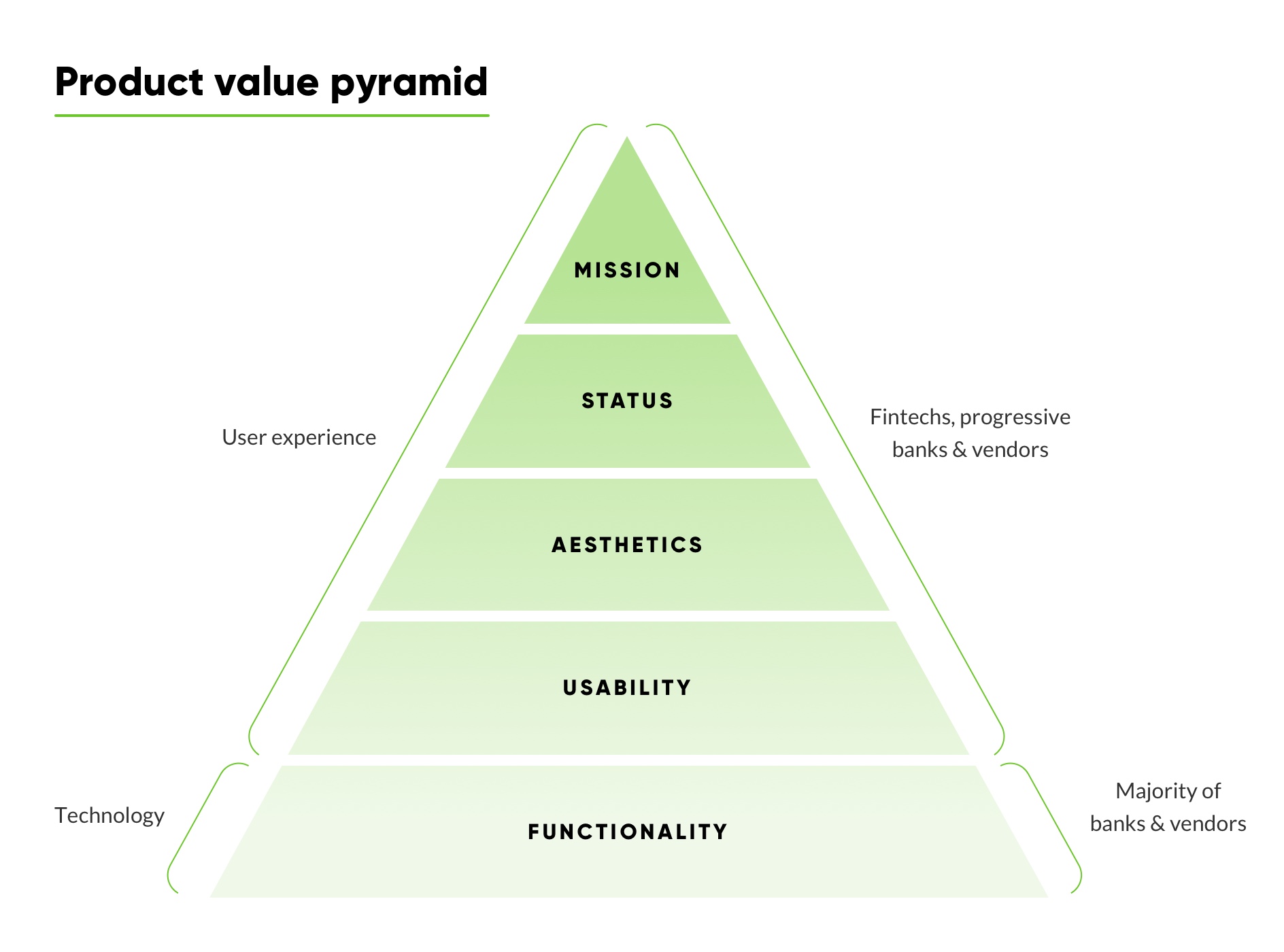
The usual financial industry approach doesn’t match the disruptive requirements of the digital world. This creates a huge gap between failure and success. Such obstacles as lack of demand, inability to compete and lack of funding make every second project fail in five years. It is crucial to understand and use the human-centered design outcomes to increase any project's chances for success. Provide an outstanding user experience to establish your service success in the digital age.
Learn more how to jump from functionality to the next-level advantages
9. Design From Customer Value Backward
Instead of beginning with available technology and asking how to package it, banks can begin with the customer problem and desired outcome, then work backward to determine journeys, capabilities, processes and technology.
The most demanded digital financial products are created using reverse engineering. We are not talking about stealing competitors’ technology by decomposing its constructs. We mean a top-down approach that begins with defining the ultimate value for the user and ends with a development plan.
This is opposite to a common approach that starts with backend coding based on business requirements, then turns to further packaging in standard design and trying to convince users that they need it.
To maximize the benefit for the users, banking superstars start with UX research to discover and define the most effective way to deliver product value to the customers, while interface design helps to materialize it into the look and feel of an actual product. They spend a lot of time and money on searching for the best product architecture, before starting the actual coding. Why? Because this is how to reduce the risk of failure caused by creating unusable, complex financial products that lead to millions in losses.
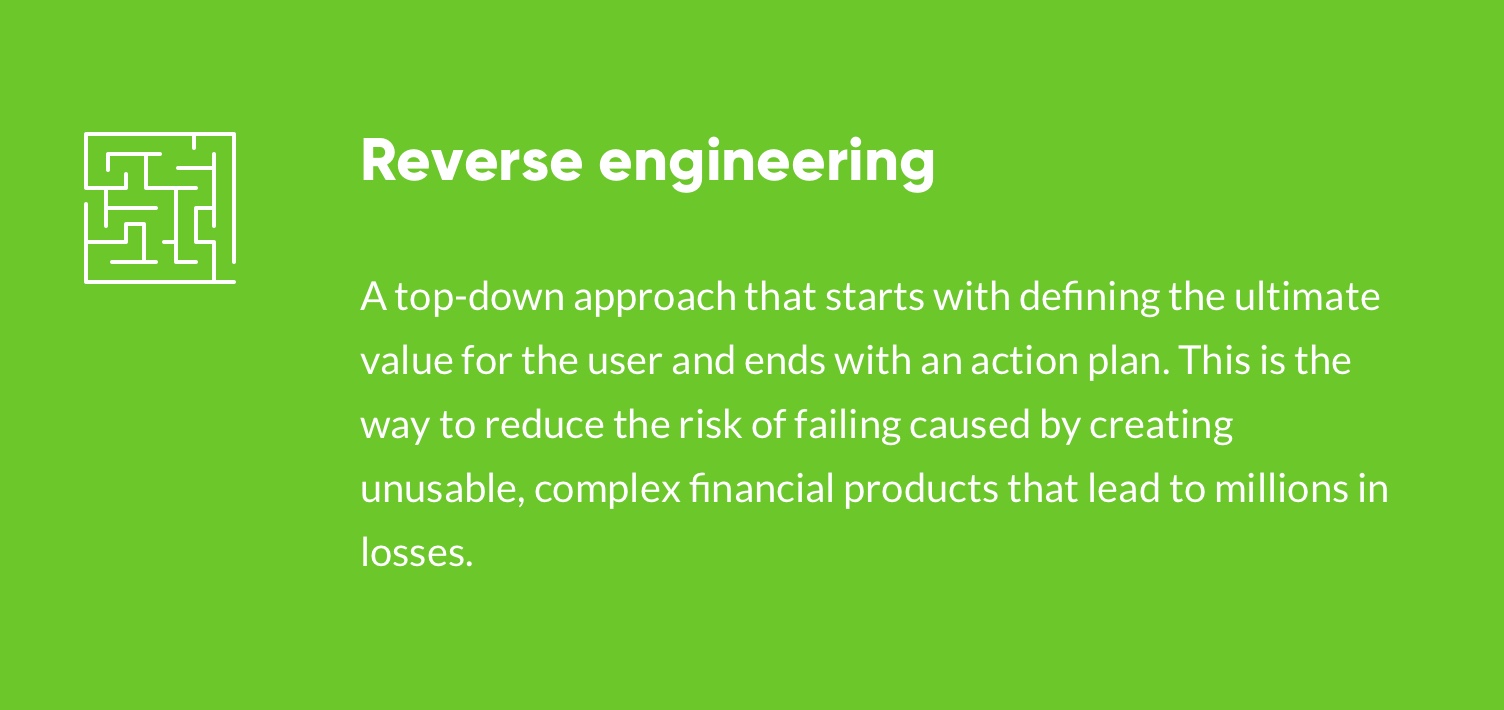
There's a saying... if you wish to predict the future, create it, and that's basically what design-centered companies do. They maximize the product's success by making sure users will get the ultimate value out of the product. Starting with validated customer value reduces the risk of investing heavily in functionality that customers do not understand, need or adopt.
I like to compare reverse engineering to a maze that has multiple entrances and only one exit. The entrances are different types of product configuration, functionality and features. And the exit is the high demand and success on the market. Usually, the entrepreneur tries to guess which configuration he/she should develop. They look around to figure out what products are trending, code a lot of features to impress customers and finally pack all this into a vibrant design to grab attention. Then they spend tons of money on advertising to convince consumers that they need this. Unfortunately, this is a very expensive Russian roulette because you will never now which configuration works best.
In reverse engineering, you significantly reduce uncertainty by starting from the maze exit and moving to the correct entry. In this case, the exit of the maze is the point at which the product is highly demanded because of the value it provides to customers.
By beginning with exploring the value that's significant to customers, we put the focus of the product and the entire business on the needs of customers.
This is not easy and very often requires a dramatic change in the company’s decision-making principles, inner cultural values and the logic of business processes. But, this pays off with growing demand and user satisfaction.
Learn more how to master value-based digital transformation
10. Competition Is Expanding Beyond Banks and Fintechs
The most important competitive threat is not necessarily another bank. Financial services are increasingly embedded into broader digital ecosystems, while AI assistants and autonomous agents may become new intermediaries between customers and financial institutions.
If customers increasingly discover, compare and execute financial decisions through third-party platforms or AI interfaces, the strategic question becomes who owns the customer relationship—even when the bank still holds the account or provides the regulated infrastructure.
I believe Nokia had different thoughts when they saw the first iPhone. They probably figured this was just some new kind of touchscreen smartphone model for a small, specific audience. It looked like nothing to worry about because Nokia produced billions of phones in dozens of models for different audiences.
Today, there are hundreds of touchscreen smartphones on the market, and only a few old-fashioned models for a small, specific audience.

Agentic banking creates the possibility that customers will increasingly delegate financial research, comparison and execution to AI. This could move significant parts of the customer relationship away from traditional mobile banking interfaces and toward intelligent intermediaries.
Banks therefore need to think beyond protecting app engagement and ask how their products, trust, Digital Brand Identity and value proposition remain visible when machines increasingly mediate financial decisions.
It's crucial to carefully evaluate the impact on millions of users. Exploring it from a user perspective is a clever way to detect disruption before it is too late. At the end of the day, it could provide insights on how you should rearrange the user experience of your product to prosper in this fast-paced digital world.
Learn more about 5 Ways to Predict Banking Disruption
How Banks Can Turn Fintech UX Lessons Into Digital Strategy
Digital strategy in banking is the coordinated set of choices that determines how a financial institution uses technology, products, customer experience, data, channels and organizational capabilities to create customer and business value. Fintech disruption showed why successful digital strategy cannot be reduced to technology modernization: it must also define who the institution serves, how it differentiates and what experience it intends to create.
To create a plan based on described digital banking trends in 2020, we offer a 6-step action plan to set user-centricity in action.
1. Diagnose Where Customer Experience Limits Strategy
Identify adoption barriers, fragmented journeys, support dependency, weak differentiation and unmet customer needs before selecting solutions.
2. Define the Customer and Business Outcomes
Translate digital strategy into measurable outcomes such as adoption, conversion, retention, cost-to-serve, trust and relationship depth.
3. Design From Customer Value Backward
Start with the target customer outcome, then define the journey, capabilities, processes and technology needed to deliver it.
4. Build Distinctive Digital Brand Identity
Avoid becoming another feature-equivalent banking app by translating strategy and brand promise into recognizable product behavior.
5. Make UX an Institutional Capability
Connect UX with product, technology, operations, risk, brand and leadership rather than treating it as downstream interface production.
6. Govern and Improve the Experience Continuously
Establish ownership, measurement and governance so experience quality evolves continuously instead of depending on periodic redesign projects.
7 Steps to a remarkable digital CX
Conclusion: Fintech Disruption Was Never Just About Technology
The historical UX advantage of many Fintechs came partly from narrower product scope, newer infrastructure and fewer organizational dependencies. Banks operate under greater product complexity, regulation, legacy technology and organizational scale.
The lesson is therefore not that banks should behave exactly like startups. It is that they should adopt customer-centered decision principles while designing them for institutional complexity.
A focused Fintech can optimize a small set of journeys. Large financial institutions must coordinate thousands of interactions across products, channels, regulations and teams. At that scale, customer-centered design becomes a systemic challenge rather than simply an interface challenge.
This is why banks need Systemic UX and UX governance: the objective is not only to create isolated Fintech-like journeys, but to make the entire financial ecosystem coherent.
Fintech disruption also demonstrated that financial brands can have recognizable digital personalities. Digital Brand Identity extends visual branding into interaction, language, motion, service behavior and emotional tone, helping similar functionality feel distinct.
Fintech disruption changed banking because technology allowed new players to challenge assumptions that incumbent institutions had treated as fixed. Onboarding did not need to be exhausting. Payments did not need to feel complicated. Financial products did not need to be designed around internal structures. And digital banking did not need to feel like a branch translated onto a screen.
The deeper lesson is that technology creates possibilities, but digital strategy determines whether those possibilities become customer value. Banks that respond by copying Fintech features may close functional gaps while creating another generation of interchangeable banking apps.
The stronger response is systemic: start with customer outcomes, design from value backward, build a distinctive Digital Brand Identity and connect UX with product, technology, operations and governance.
AI now raises the same strategic question at a much larger scale. The institutions that benefit most will not necessarily be those that adopt new technology first, but those capable of translating it into coherent, trusted and distinctive financial experiences.
That is the lasting lesson of Fintech disruption: competitive advantage does not come from being digital. It comes from what the institution is able to make digitalization mean for the customer.
Fintech Disruption and Banking UX: Key Questions
What is Fintech disruption in banking?
Fintech disruption in banking is the structural and competitive change created by technology-enabled financial companies that introduce new business models, services and customer experiences. Its impact extends beyond technology by raising expectations for speed, simplicity, personalization, transparency and digital-first service.
Why did Fintech companies disrupt traditional banking?
Many Fintechs combined modern technology with narrower product scope, customer-centered design and simpler operating models. This allowed them to challenge established assumptions about how financial services needed to be delivered and raise customer expectations for digital experience.
Is Fintech disruption mainly about technology?
No. Technology enables new capabilities, but disruption occurs when those capabilities create meaningful customer or business value. Many banks have access to similar technologies but achieve different outcomes because their strategy, operating model and customer experience differ.
What can banks learn from Fintech UX?
Banks can learn to start with customer problems, simplify financial complexity, validate product assumptions earlier, design coherent journeys and treat UX as part of product strategy rather than as interface decoration after requirements are defined.
Should banks copy successful Fintech apps?
No. Benchmarking can reveal useful patterns, but copying competitors often leads to feature parity and generic banking experiences. Banks should understand why a Fintech solution works and translate that principle through their own strategy, customer needs and Digital Brand Identity.
Why is customer-centricity important to banking digital strategy?
Digital strategy determines how technology and organizational capabilities create value. Customer-centricity helps ensure those investments solve meaningful problems rather than simply digitizing existing internal processes.
How has feature parity changed digital banking competition?
As payments, cards, onboarding, savings, investing and other capabilities become widespread, individual features provide less sustainable differentiation. Customer experience, trust, personalization and Digital Brand Identity therefore become increasingly important sources of preference.
What is the role of UX in banking digital transformation?
UX helps translate strategic and technological change into experiences customers can understand, adopt and trust. It also provides customer evidence that can guide decisions about which problems should be solved before major implementation begins.
Why can Fintech UX be difficult for large banks to replicate?
Large banks operate across more products, regulations, legacy systems, channels and organizational structures than focused Fintech startups. Their challenge is therefore not only creating a good interface but maintaining coherent experience decisions across an interconnected financial ecosystem.
How does Digital Brand Identity help banks compete with Fintechs?
Digital Brand Identity turns the bank’s strategy and personality into recognizable digital behavior through interaction, communication, visual language, personalization and emotional tone. It helps prevent the institution from competing only through easily copied features.
How is AI changing Fintech disruption?
AI can accelerate product creation, personalization, automation and customer interaction while introducing new intermediaries such as autonomous financial agents. This may shift competition from individual banking apps toward intelligent ecosystems capable of acting on customers’ behalf.
What should banks do next to remain competitive?
Banks should connect digital strategy with validated customer needs, design from desired outcomes backward, strengthen Digital Brand Identity, integrate UX upstream into product decisions and establish governance that keeps the experience coherent as technology evolves.
Turn Digital Strategy Into a Coherent Banking Experience:
 UXDA partners with banks and financial organizations to translate digital strategy into customer-centered products and coherent financial ecosystems. Through Systemic UX, customer research, Digital Brand Identity and experience governance, we help institutions move beyond feature imitation toward sustainable experience differentiation.
- E-mail us at info@theuxda.com
- Chat with us in Whatsapp
- Send a direct message to UXDA's CEO Alex Kreger on Linkedin